Max slammed his palm against the counter harder than necessary.
Joy didn’t look up.
“You’re pacing again,” she said.
“I can’t help listening.”
“For what?”
“That fucking bell.”
Joy folded her arms across her chest. “It just passed.”
“Someone is testing something.”
“Who?”
“Up top.”
Joy shrugged.
Max moved toward the window and back again. The room held him the way the floor always did. Its furniture had been arranged not for comfort but for function, organized and reorganized so many times that the space had come to reflect whoever was using it most.
Joy watched him for a moment longer. “You remember the last one?” she asked.
Max stopped pacing. “Yeah. Samantha. She’s on Sixteen now.”
Joy leaned against the wall. “How long’s it been?”
Max counted silently. “Six months.”
“Closer to seven,” Joy said.
He shook his head. “Doesn’t feel like it. There’s six of us now.”
Joy nodded once. “I remember when she got here she couldn’t sleep.”
Max exhaled through his nose. “She couldn’t stop shaking either.”
“At some point they all need to go to Nineteen,” Joy said.
Max glanced toward the hallway instinctively.
❧
Michael lived on Floor Nineteen, in the bigger apartment at the end of the hall. Extra blankets were visible through the open door whenever anyone passed, with supplies stacked along the far wall in arrangements that hadn’t shifted in months. The door was always open. No one had ever been told to come in.
“He doesn’t complain,” Joy said.
“No,” Max agreed.
He leaned back and listened.
Half-bell.
Sixteen.
Half-bell.
Seventeen.
The car passed without stopping.
❧
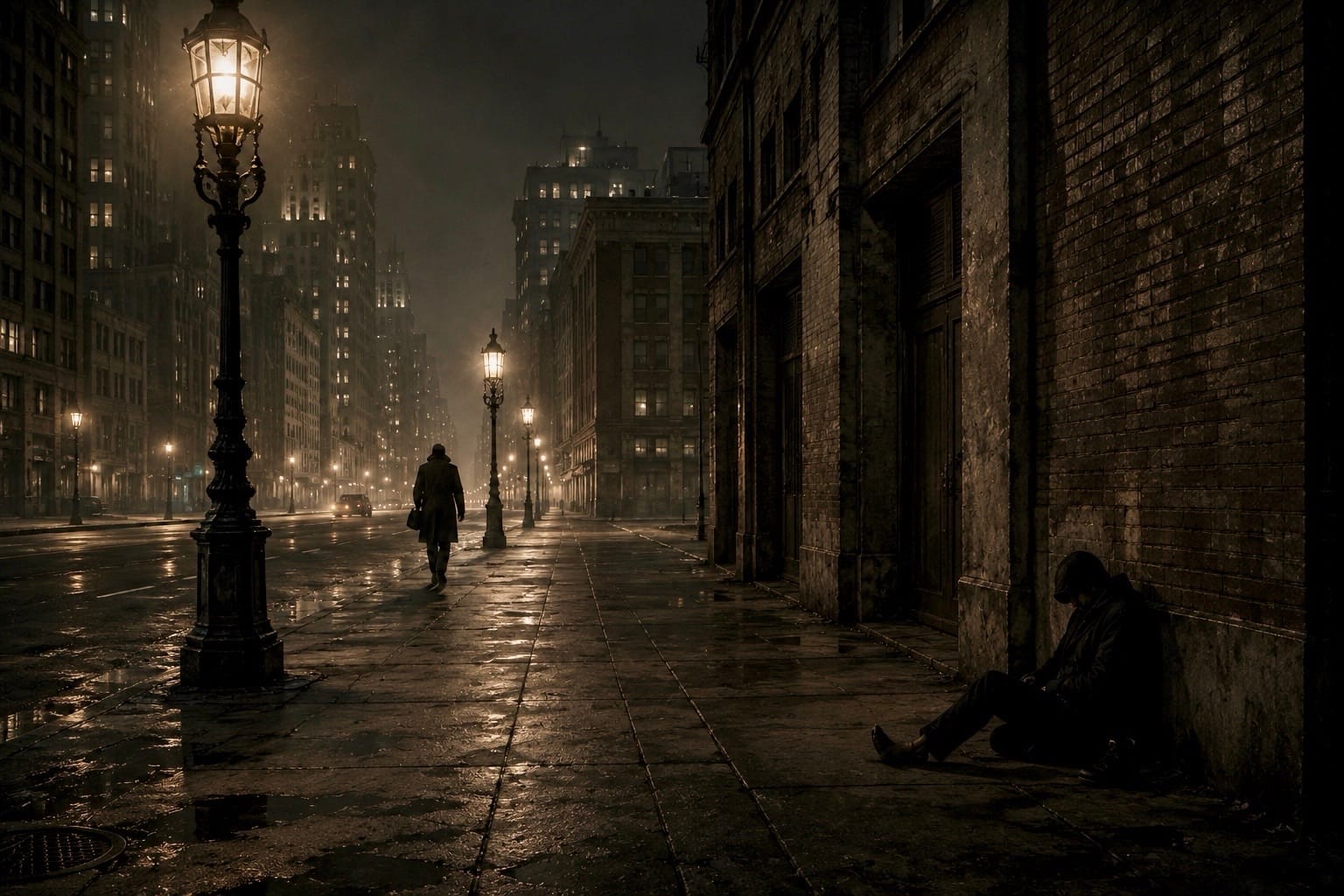
The street was colder than it looked.
Wind moved through it in narrow corridors. It was the kind of city that had been built for more people than currently used it, its avenues too wide now, its intersections holding more space than the traffic required. The buildings that remained stood at uneven intervals, their facades intact but their purposes changed or abandoned, occupied in ways their architects had not anticipated.
A delivery truck passed without slowing. A woman crossed against the signal and kept walking. A traffic light cycled through its sequence for no one in particular.
The city still functioned. It had simply stopped filling.
A man walked with steady steps along the far sidewalk, hands deep in his coat pockets. The large bag over his shoulder held a folded canvas, three decks of cards, a roll of industrial tape, an assortment of fruit, and two paper-wrapped loaves of bread. The order cards had been specific.
He preferred that. Specific meant attention.
He moved without urgency past a row of streetlamps, their ornamental iron bases furred with rust at the joints, the glass enclosures still intact. One flickered at irregular intervals, its timing tied to nothing mechanical anyone had recently serviced.
He turned the corner.
That was when he saw the figure.
Slumped against the brick wall of a warehouse long emptied of its name. One shoe missing. Hood pulled halfway across his face. Breath visible in short, shallow bursts against the cold air.
The man approached without urgency.
He crouched and placed two fingers to the neck.
A pulse. Faint. Present.
The boy stirred slightly at the touch. His eyes flickered open, then rolled back.
The streetlamp above cast a thin halo around them both, light breaking against drifting particles in the cold air: grit, dust, something the city shed continuously without accounting for it.
The man slid one arm behind the boy’s shoulders.
The body was light. Too light.
He lifted him carefully, settling the weight across his shoulder with the practiced steadiness of someone who had done this before and did not require an audience for it.
The boy’s head lolled forward. His eyes opened again, briefly trying to locate something, then closed.
The man held him steady. He did not soften his voice.
He did not raise it either.
“Tell me your birthday.”
❧