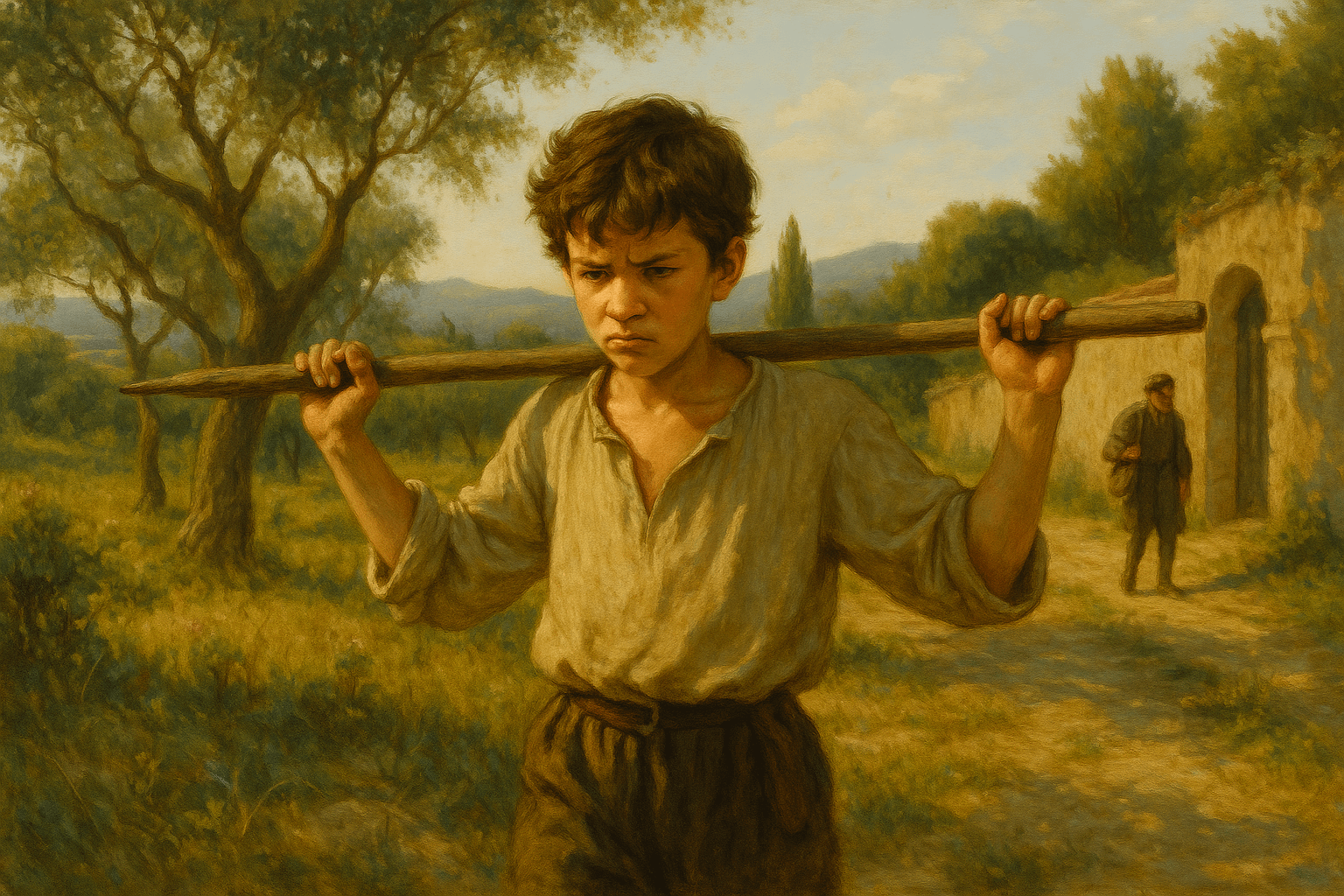
The heat that summer pressed the orchard into a heavy stillness.
Bees drifted low over fallen fruit, the air thick with the sour-sweet tang of ferment. Nico moved through it without purpose, his wooden pike slung across his shoulders, arms resting easily along the shaft. The paths that had once felt like routes of discovery now seemed too small, too known. His gaze wandered past the trees, toward the low wall, and beyond it.
The orchard no longer held him the way it had.
Something in him had begun to lean outward.
Pride had taken root quietly, then spread. It was not loud or boastful, not yet. It lived beneath his thoughts, shaping them. When he watched other boys, he did not wonder what they might become.
He measured them.
And found them lacking.
At home, there was nothing to correct him.
Marietta praised him easily, her voice warm with a pride that asked nothing in return. She admired the way he carried himself, the strength in his grip, the quickness of his hands. When he spoke over her, she laughed. When he dismissed a chore, she waved it aside. There would be time for that later, she said.
Nonna was softer still. Her hands lingered at his face and shoulders, smoothing, adjusting, admiring. To her, he was not becoming something—he was already something worth protecting from the harder edges of the world.
Between them, Nico lived inside a certainty that required no testing.
No one asked more of him than he already believed himself to be.
And so he began to believe it more deeply.
Admiration, left unanswered, does not settle.
It sharpens.
❧
The Bite of Jealousy
He had seen Stefano in the stable yard a week earlier, balancing an apple on his nose while two village girls laughed themselves breathless.
Nico had stood apart, arms folded, watching.
At first, he had told himself it was foolishness. Stefano had always been a fool—too eager, too loud, too pleased with himself. The girls would tire of it quickly.
They did not.
They leaned in. They watched. They chose to stay.
Something in Nico tightened.
It was not confusion. He did not question why they laughed or what they saw.
He understood it clearly.
It should have been him.
The thought came without hesitation, without doubt. It did not arrive as a wish, but as a correction—as though something in the world had briefly misaligned.
He turned away before they noticed him, jaw set, the image following him back into the orchard.
The heat there seemed heavier than before.
He drove the butt of his pike into the bark of a tree, once, then again, until flakes tore loose and scattered at his feet. The impact traveled up his arms, sharp and satisfying. He struck again, harder this time, imagining resistance, imagining something that could push back.
When a rabbit edged from the underbrush, he turned on it immediately, shouting, advancing, the pike dropping into his hands with a familiarity that bordered on instinct.
The animal bolted.
Nico followed two steps farther than he needed to, breath quick, pulse high, before stopping himself.
The orchard fell quiet again.
He stood there a moment longer, the pike still raised, as though something in him had not yet finished.
❧
Donato
From the lane beyond the wall, Donato paused at the broken gate.
A sack of wool and thread hung from his shoulder, but he did not shift its weight. His attention settled fully on the boy in the orchard—the set of his stance, the tension in his arms, the way he held the pike even after the moment had passed.
Donato had seen this before.
Not the play.
The hold that followed it.
He did not call out.
He did not interrupt.
He stepped through the gate instead, slow enough that his presence arrived before his voice might have. The sound of his boots in the dust carried just far enough.
Nico turned, the shift in him immediate.
The tightness in his shoulders eased. The look in his eyes flattened, then sharpened into something more guarded. The pike lowered, though not entirely.
A small scowl replaced what had been there before.
Donato lifted a hand in greeting, nothing more.
He walked on.
The boy watched him go.
Donato felt it without turning.
A boy with heat in him could be guided.
A boy who began to prefer it—that was different.
And here, there were no hands steadying him. No voice cutting cleanly across the grain of his thoughts. Only warmth. Only praise.
Donato adjusted the sack on his shoulder, though its weight had not changed.
❧
Forging
That evening, Nico sat in the courtyard with a whetstone and his wooden pike.
He worked the stone along the tip in uneven strokes, listening to the dry scrape, imagining the sound it would make if it were steel. In his mind, the wood hardened beneath his hands. The edge formed. The weapon became something worthy of him.
Marietta passed behind him with a basket of laundry, humming softly. She paused, as she always did, to touch him—fingers in his hair, light and affectionate.
“My handsome knight,” she said, smiling as though the word had already proven itself true.
Nico did not look up.
He leaned into the touch without thinking.
She moved on.
The sound of the stone continued.
From the workshop doorway, Donato watched in silence.
The boy did not question the word.
He accepted it.
That was what unsettled him.
A child corrected learns the shape of the world.
A child confirmed learns only himself.
Donato exhaled slowly, the breath thin as thread between his teeth.
He had known boys like this.
Not many.
But enough.
They moved forward without hesitation. They did not second-guess. They did not fracture under pressure the way others did.
And when the world demanded something hard of them—
they answered.
Not always well.
But always fully.
He turned back into the workshop, the familiar weight of cloth and needle waiting for him.
Behind him, Nico continued his work, each pass of the stone smoothing the wood, refining it in his mind into something sharper than it was.
Something closer to what he believed himself to be.
And closer, though he did not yet know it, to what the world would one day require of him.
❧