✥ Chamber Tale XXI
Jeremy Price hadn’t eaten in eight days.
He waited outside the bakery on Central Street until the owner unlocked the door and propped it open against the morning air.
“I’ll sweep the walk,” Jeremy said. “And the bakery floor besides, if you could spare a loaf.”
The baker looked him over. Thin. Tired. Still standing straight as though the young man decided that posture is the last thing he intends to lose.
“You know how to use a broom?”
Jeremy smiled. “I’ve had practice.”
An hour later he sat on the curb with warm sourdough in his lap, tearing away careful pieces so it would last. By afternoon he had wandered farther into town than he’d intended, and outside the post office a fresh notice had been stapled to the public board.
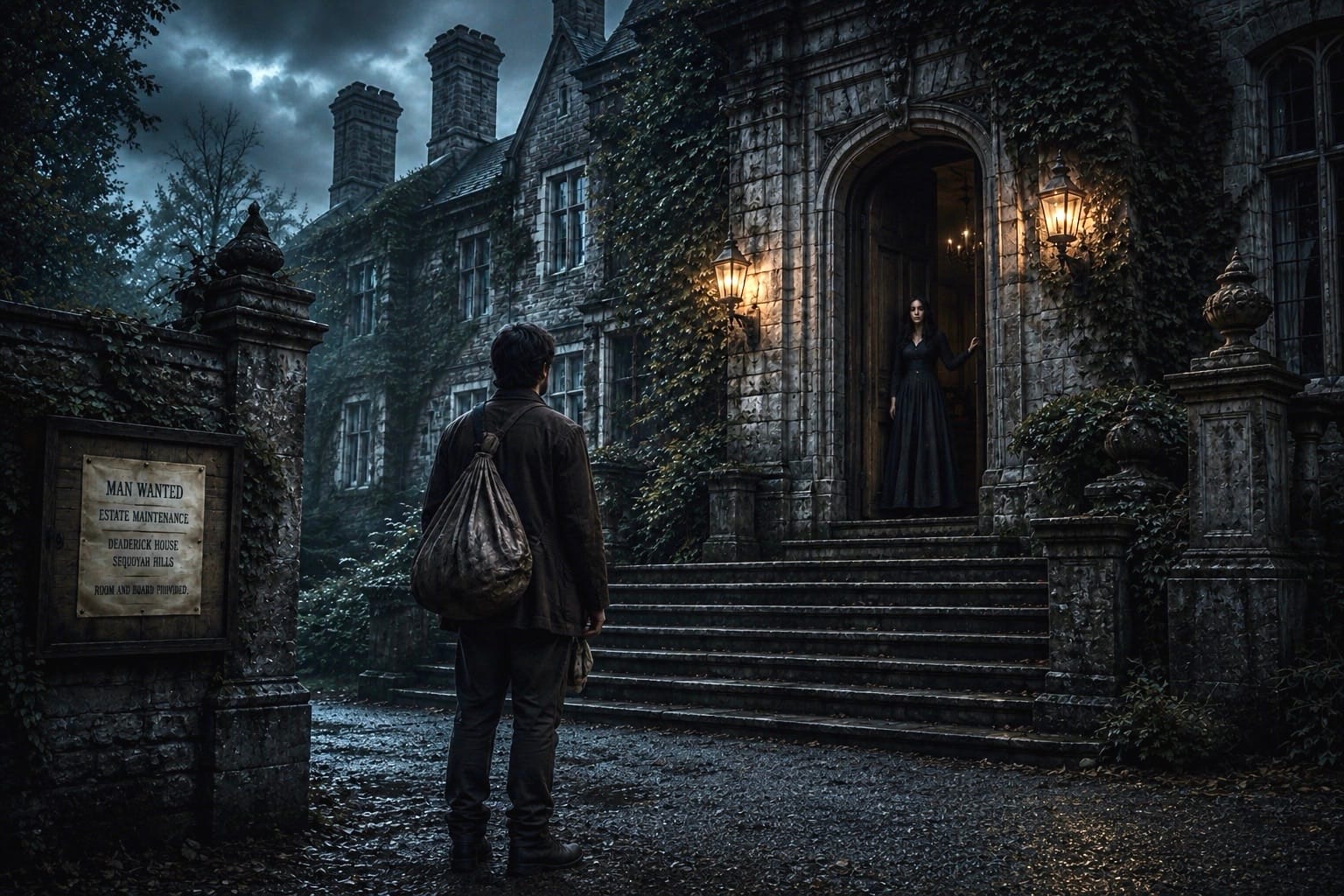
MAN WANTED — Estate Maintenance.
Deaderick House. Sequoyah Hills.
Room and Board Provided.
Jeremy copied the address into the palm of his hand. Before sunset he was already walking.
✥
The river became his companion through the night, and by dawn he stood at the foot of a long gravel drive disappearing into the hills.
The climb was steeper than it looked, and a cool wind drifted down the slope despite the warmth already gathering in the valley below. After the second bend, the house appeared.
Stone walls climbed toward the eaves beneath ribbons of ivy. Tall chimneys rose above the roofline like clenched fists. Some windows stood open. Others remained shuttered. None of them reflected the morning.
Jeremy climbed the broad front steps and knocked twice. The door opened almost immediately.
A young woman stood before him, no older than nineteen, her hair black as raven feathers to her waist, her eyes an impossible pale blue. Jeremy forgot, briefly and completely, why he had come.
“Can I help you?”
“I—” He cleared his throat. “Is the owner home?”
“Whom shall I say is calling?”
“Jeremy Price.”
She smiled. “I’ll tell him.”
As she disappeared down the hall, he noticed she made almost no sound crossing the old floorboards.
✥
The owner introduced himself simply as Mr. Deaderick — courteous, economical with words, the kind of man who asked questions like he already knew most of the answers.
“You’ve worked estates before?”
“No, sir.”
“Gardens? Stonework?”
“No to both.”
Mr. Deaderick studied him a long moment. “What have you done?”
“Whatever someone needed.”
The older man nodded once, as though this were the correct answer to a question he’d been asking a long time. “That may be enough.”
He led Jeremy through the grounds. He showed him stone walls needing repair, orchard trees needing pruning, gutters, fences, shutters that never seemed to stay square.
They stopped at a small cottage beneath two maples.
“Your quarters.”
Simple. Clean. A narrow bed, a table, a stove. After sleeping beneath bridges, it felt like a palace.
“I can pay twenty dollars a week.”
Jeremy looked around the room again. “You’ve already paid me.”
✥
The seasons passed quietly.
Old estates, Jeremy discovered, never finished needing attention. Spring belonged to gardens, summer to paint, autumn to roofs, winter to stone, and almost every morning a folded note waited outside the cottage door.
The greenhouse latch sticks again. — D
The orchard pump loses pressure after heavy rain. — D
One of the west terrace steps has shifted. — D
He never saw who left them. He never questioned it. He simply completed the work.
He saw Dorothy crossing the grounds sometimes — beside the fountain, beneath the orchard trees, watching the river from the upper terrace — and she never seemed surprised to find him there.
Their conversations stayed brief at first, then longer, then effortless. She knew every path through the woods, every tree by name, every room inside the house, and yet she admitted once, almost casually, “I’ve never been into town.”
Jeremy laughed. “You’ve lived here your whole life.”
“I’ve never needed to leave.”
“Then Saturday.”
“What happens Saturday?”
“I’ll show you.”
Her smile lingered a moment before it faded. “I don’t think I can.”
“Why not?”
She looked toward the house behind them, and something in her face closed like a door being eased shut rather than slammed. “I’ve simply never gone.”
✥
Winter settled over Sequoyah Hills, and snow gathered along the stone walls while Jeremy spent his evenings reading beside the cottage stove.
One night another note appeared.
The library window won’t latch. — D
He found her there before the fire, looking at the books.
“You always know what needs fixing,” she said.
“Old houses tell you.”
He reached for her hand. This time she did not pull away.
“I’ve been thinking,” he said.
“So have I.”
“When spring comes—”
She looked down. “I know.”
“I want to marry you.”
Sadness entered her eyes for the first time since he’d known her. “You shouldn’t.”
“I didn’t ask whether I should.”
She touched his face gently. “I know.”
✥
The following morning Jeremy mentioned her at breakfast, and Mr. Deaderick lowered his newspaper slowly, the way a man lowers something he already suspects he won’t like looking at.
“Miss Dorothy,” Jeremy said. “She told me the library window needed repairing.”
“I repaired that window myself. Twenty years ago.”
Jeremy laughed. “No, sir. She left me a note.”
He set the folded paper on the table between them.
Mr. Deaderick did not pick it up. He only looked at it, and something in his face went very still. It was not surprise. It was the stillness of a man confirming something he had spent a long time hoping he wouldn’t have to.
“Read it to me,” he said.
Jeremy frowned, but obliged. “The library window won’t latch. Signed, D.”
“I don’t doubt you heard those words,” Mr. Deaderick said quietly. “But there is nothing written on that page, Mr. Price. There never was.”
Jeremy looked down at the paper in his own hand.
Blank.
He had carried it folded in his pocket for two days. He had read it twice more before breakfast, certain of every letter. And it was blank, had perhaps always been blank, in every way that mattered to anyone but him.
“I’ve never had a daughter,” Mr. Deaderick said. Not unkindly. Almost gently, in the manner of a man passing on an inheritance he never wanted to hold either. “This house has had one, off and on, for longer than I’ve owned it.”
Neither man spoke.
✥
Outside, workmen were unloading long sections of black iron from a wagon at the foot of the drive. New fence posts, Mr. Deaderick had said the week before.
Jeremy no longer wondered whether they were meant to keep something out.
He returned to the library after sunset.
The fire had burned low. The window latched without complaint.
Dorothy stood where she had the night before, her hand resting lightly on the back of the chair.
She smiled when she saw him.
“He told you.”
Jeremy nodded. “He says you aren’t his daughter.”
“No.”
“He says no one else has ever seen your notes.”
“No.”
Jeremy looked at her for a long time.
He realized, with surprising calm, that none of it mattered.
She was here. She had always been here.
“Will you leave?” she asked.
He looked toward the dark windows. Toward the road disappearing into the trees.
Then back to Dorothy.
“No.”
For the first time since they had met, she wept.
Jeremy stepped toward her. Before he reached her, she was gone.
The room stood empty.
Only a single folded note rested upon the windowsill.
He opened it carefully. For just a heartbeat, neat black ink appeared upon the page.
Thank you. — D
Then the words dissolved into blank paper.
Jeremy folded the note once more and placed it inside his coat.
✥
The following morning the workmen waited beside the entrance drive. One of them rested a gloved hand upon the first iron gatepost.
“Morning, Mr. Price.”
Jeremy looked up.
“Where would you like this one?”
He glanced toward the manor.
High above, a figure stood for only an instant at the library window. Long black hair. Pale blue eyes.
Then she stepped back into the house.
Jeremy looked again at the gatepost.
“A little farther left,” he said.
“It ought to last.”
✥
Years passed quietly on the hill.
The maples grew broader. Ivy climbed higher.
The iron gate weathered from black to charcoal.
In town, the notices on the bulletin board changed with the seasons.
One autumn morning, among advertisements for hay, livestock, and roofing work, another appeared.
GROUNDSKEEPER WANTED
Deaderick House
Room and Board Provided.
✥
This door closes quietly.