✥ Chamber Tale XI
Étienne believed clarity was kinder than comfort.
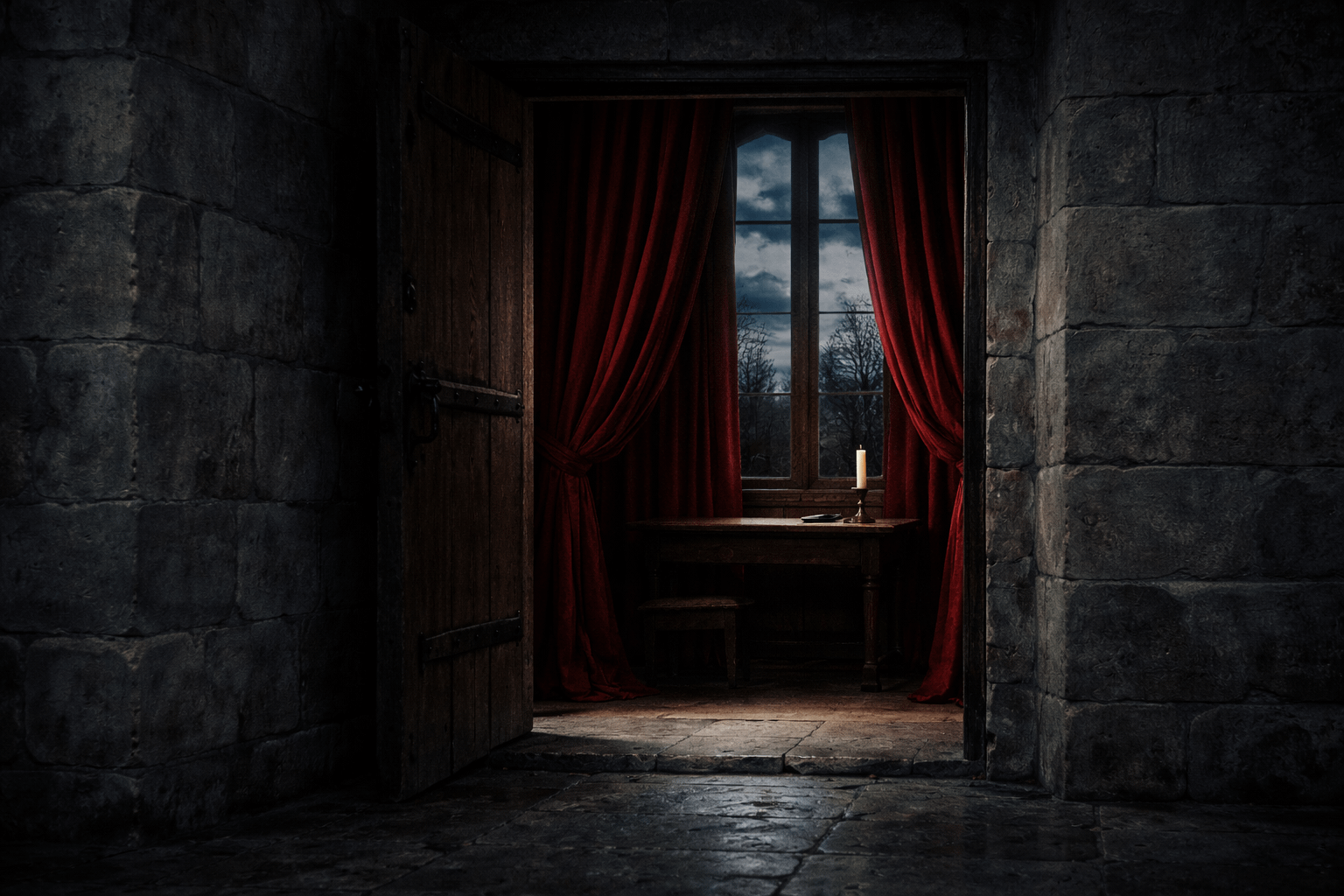
His chamber sat just off the cathedral school—narrow, tall, stone holding winter long after it left the streets. Students came to learn precision. He stripped arguments to their frame and left them standing without ornament.
Margot came because she was permitted.
She listened first. Carefully. She learned the rhythm of his pauses, and the way he corrected without humiliation. When she spoke, it was not to be heard—but to be exact.
Once, she disagreed with him.
He looked at her longer than necessary.
Recognition passed between them then. Not attraction. Something rarer: relief.
✥
Presented
Margot did not return carelessly.
She came arranged.
Her hair was pinned with intention, not extravagance—drawn back to reveal the steadiness of her gaze. Her dress was chosen for how it moved when she walked, how it held when she stood still. Wool, well-kept. Clean embroidered cuffs.
She understood beauty the way she understood language: as structure.
When Étienne spoke, she watched his hands, not his mouth. When he turned toward the board, she placed herself where the returning light would fall. She learned how to sit so that she could be seen without asking.
He noticed—but did not think of it as noticing.
He believed she came for the lesson. For order. For the discipline he brought to thought. He believed his attention—precise, unwavering—was the draw.
Margot believed otherwise.
She believed she was offering balance: intellect answered by presence, thought met with form. Being beautiful to look at was not vanity. It was contribution.
She continued to come.
✥
Watching
Étienne grew accustomed to her.
To the way she folded her hands when thinking. To the way she waited before answering. To the way her beauty never asked forgiveness.
He studied her. Enjoyed her company—looking at her, listening to her, letting conversation move more easily when she was near.
But he did not invite her in.
Not into his rooms. Not into permanence.
He believed restraint was wisdom.
He believed she would value his intellect, his praise—that being so completely seen would suffice.
That recognition was, in itself, a form of shelter.
Margot felt the edge of this and said nothing.
She had shown him the path to her heart.
He stopped before it.
✥
Unadorned
One morning, Margot came plain.
No pin in her hair. No shaping at the waist. Her dress was warm, serviceable, unremarkable. Her hair fell as it wished.
The cold found her more quickly this way.
Étienne noticed—and misunderstood.
He thought she was simplifying. Signaling contentment with less.
Margot was testing him.
If I am not something to look at, will you still make room for me?
At the end of the lesson, he hesitated—then spoke as if offering mercy.
“There is a room,” he said. “Not here. Adjacent. Quieter. Discreet.”
A room.
Not his. Not shared.
Designed around her.
He believed he was generous.
Margot understood.
✥
Refused
She did not argue.
She nodded once, as if a calculation had resolved.
Praise and company were common currency to her. Nearness invited his gaze. Permanence invited his fear.
He wanted companionship without residence. Visibility without belonging.
She wanted the opposite.
She did not take the room.
✥
Revoked
What followed was inevitable.
They separated quietly—not with spite, but with heartache. A vow might have opened a door; silence kept it closed.
Margot believed words created passage. Étienne believed only in illumination.
He was wrong.
Punishment arrived cleanly.
Margot withdrew, careful to remain unseen.
The room vanished.
The offer, revoked.
✥
Letters
They wrote.
Étienne wrote as if language might rebuild what space had denied. Margot wrote with restraint—weather, hymns, the discipline of absence.
She adapted.
He did not.
Their love survived only in ink—flattened into lines to be copied, archived, misunderstood.
Years later, Étienne’s words would be quoted in warm rooms. Folded into cards.
Margot’s letters would be preserved in red by hands that never knew her face.
And somewhere beyond heartache—beyond beauty, beyond intellect, beyond the room she never entered—Margot learned the final truth:
That being seen is not the same as being allowed to stay.
✥
Some silences don’t end.
They multiply.
With the absence of depth we only skim the surface. Not unlike a lavish meal with all the trimmings, the appreciation of the wine is a moot point. While the tide pool may be inviting we need be cautious of the snapping turtle below as it may be just as easy to loose our footing as it is to walk away from the invitation to live unconditionally
Beautifully put. Depth carries both nourishment and risk. Thank you for reading so carefully.