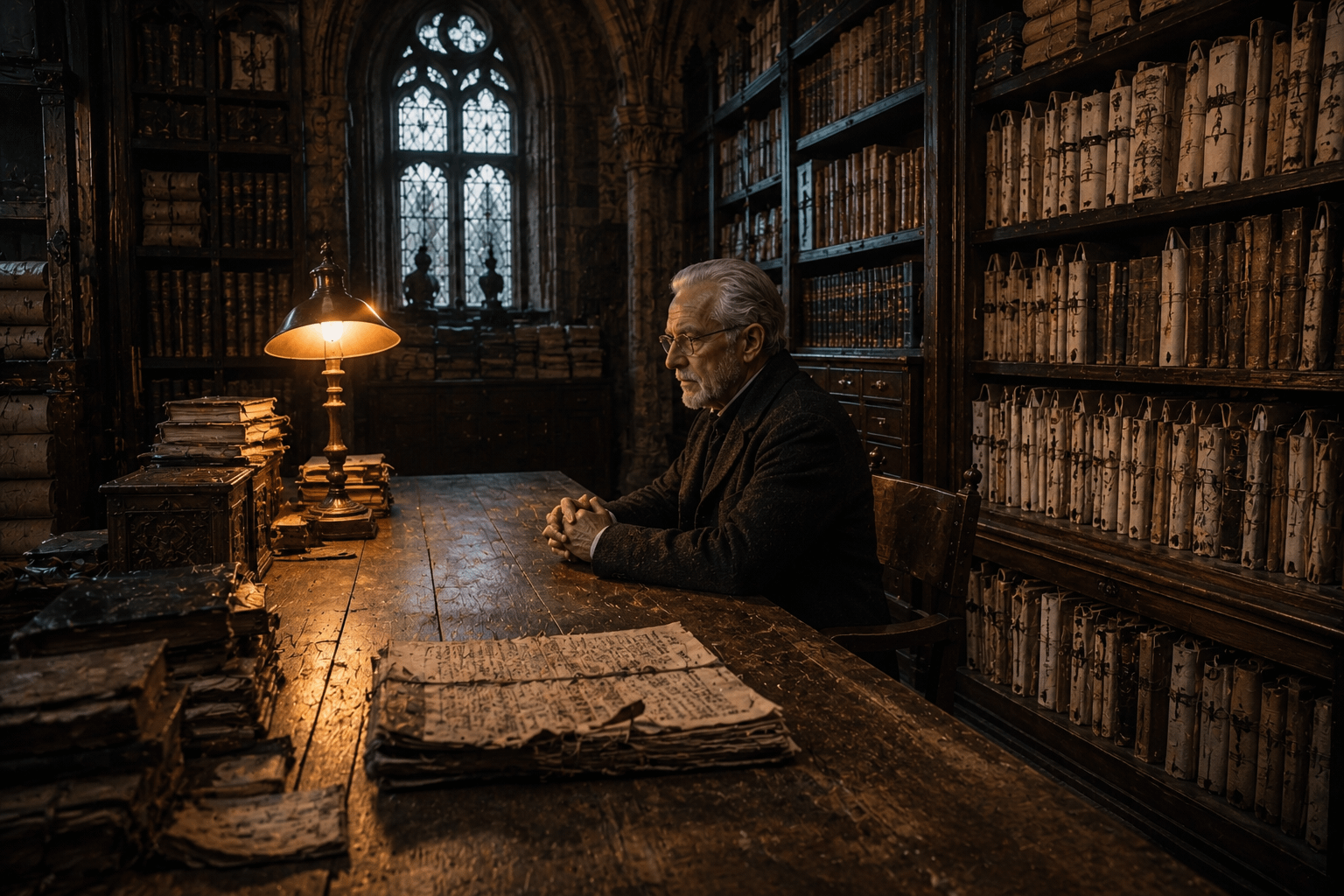
The archive was kept in a building behind the cathedral that had once housed minor clergy and now housed their absence.
Shelves. Storage cabinets. A climate system that hummed without stopping to preserve documents older than anyone responsible for them. The air inside was cool and deliberately dry. It smelled like controlled time.
The historian sat at the long table near the rear wall.
His name was Martín Echevarría. Most of the staff called him Martín. He had worked in the archive longer than anyone could easily remember, which in an institution like this one was less a biographical detail than a structural fact. He was part of what held the place together. Like mortar. Like silence.
Tommaso approached quietly and placed the folder on the table.
Martín looked up, removed his glasses, and studied him with the expression of someone confirming a memory before deciding whether it was accurate.
You’re the young man working with Padre Arriaga.
Yes.
Martín gestured to the chair opposite.
❧
Tommaso opened the folder and turned the document so the historian could read the margin where the clause appeared — the line he had marked in pencil, small and deliberate.
I wanted to ask about this grant, Tommaso said. It permits the Church to occupy the land during a period of necessity. But I have not found any record that the condition was ever closed.
Martín read the line without speaking.
His eyes moved slowly. They paused on the Latin phrase. He did not reach for his glasses.
When he finally looked up, something in his expression had reorganized itself.
Where did you find this copy?
In the preservation files. It was included with the materials for the structural review.
Martín nodded once.
That makes sense.
He leaned back and folded his hands across his chest.
You’re correct about the clause, he said. It describes temporary occupation. It assumes the necessity would eventually end.
So there should be another document, Tommaso said. Something that acknowledges the resolution.
Martín did not answer immediately.
He returned his attention to the page as though the ink might rearrange itself under closer examination. The climate system hummed behind the shelves. Nothing else moved.
There isn’t one, he said finally.
None at all?
None that anyone has found.
He closed the folder and slid it back across the table.
This question has appeared before, he continued. Not frequently. But often enough.
Tommaso felt the folder’s weight in his hands.
And what was the conclusion?
❧
Martín rose from his chair and carried one of the open volumes back to its place on the shelf. His movements were unhurried. The gestures of someone who had long ago made peace with the pace at which institutions preferred to move.
When he returned he looked at Tommaso with an expression that contained neither warning nor encouragement.
The conclusion, he said, was that the cathedral had already stood for several centuries.
Tommaso waited for him to continue.
Martín did not.
He picked up his glasses and returned them to his face. His eyes moved toward the high window where gray light fell across the shelves without reaching the floor.
You’re thorough, he said.
I try to be.
Accuracy matters.
Tommaso nodded.
But sometimes, Martín added quietly, accuracy arrives after the decision has already been made.
Tommaso’s eyes narrowed. An unintentional smile crossed his face.
Martín looked back without expression.
❧
Tommaso gathered the folder and stepped back into the courtyard.
The clouds had thinned. A pale strip of sky had appeared above the cathedral towers.
He stood there for a moment.
Martín knew. That much was certain. He had known before Tommaso opened the folder. Possibly before Tommaso arrived.
The archive held the question.
The historian held the answer.
Neither had been asked to speak.
❧