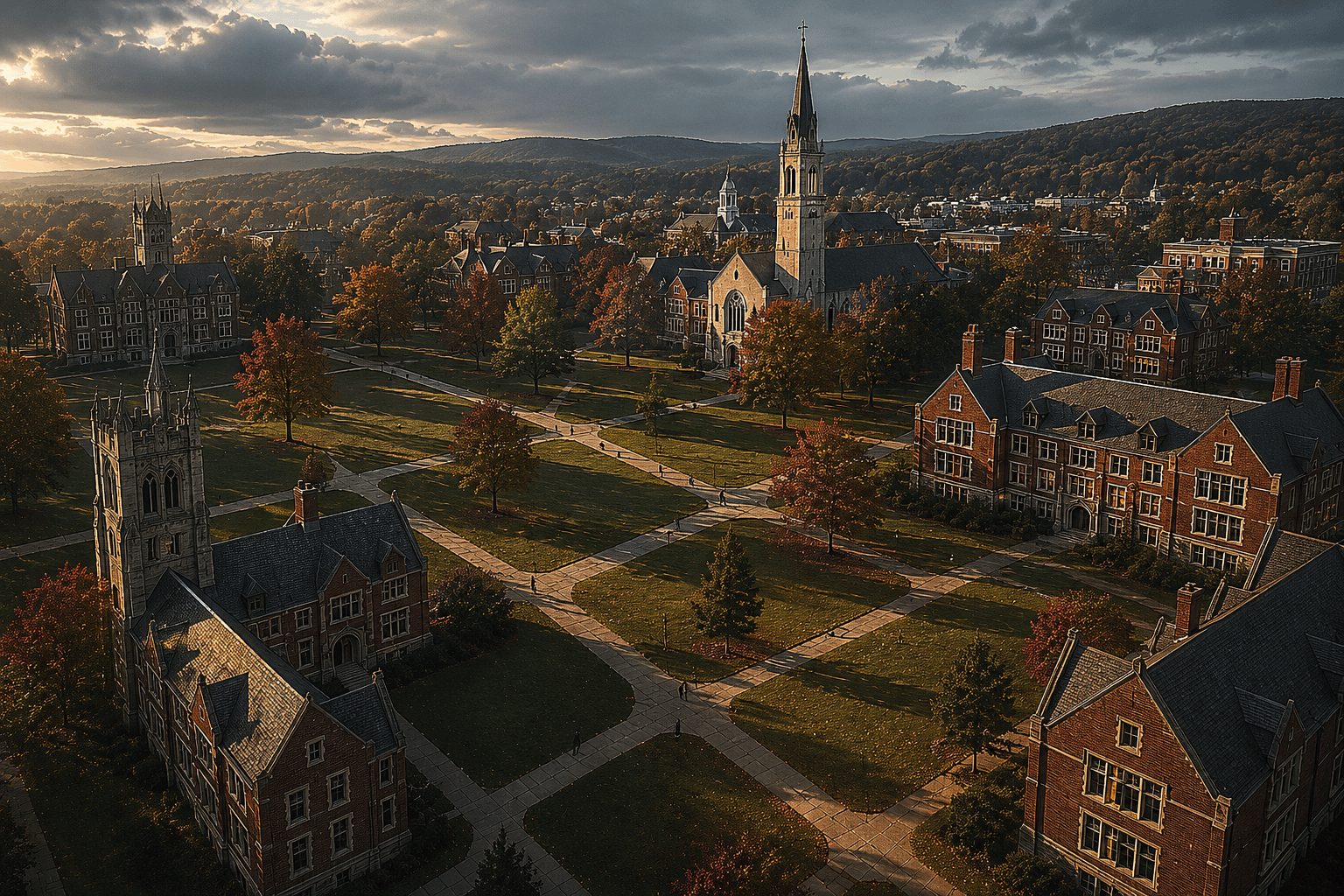
In the southeastern quarter of the state, where concrete softened into cultivated soil and the highway fell quiet beneath trees again, a university rose from the landscape like a promise someone had actually kept.
Harkness University did not look like a place where evidence disappeared.
The campus rested between a slow-moving river and a wooded ridge, its stone paths curving with the land as though they had grown there naturally instead of being laid by hand. Birch and ginkgo trees lined the walks. Students crossed the commons beneath the last warmth of autumn light.
It looked preserved.
Untouched.
Like the kind of institution that still believed knowledge made people better. That illusion lasted exactly until you reached the Henley-Moore Center for Genome Science.
The genetics building was different from all of it.
Four stories of black-framed glass and sun-responsive louvers, the Henley-Moore Center sat like a surgical instrument among ruins. Its name was etched into slate beside a plaque honoring its founders — faces in bronze wearing guarded expressions, equal parts pride and regret.
Inside, the silence was engineered.
❧
The Lecturer
The lecture hall filled slowly, blue lighting casting a clinical calm over tiered seating. Information pulsed across the display walls — chemical diagrams, sequencing logic, and a single line of suspended text:
In the beginning was the code.
Some students whispered: was it biblical? Was it from Jobs?
Laptops flickered on. Styluses tapped. A cough, a yawn.
No one looked at the door when it opened — but everyone noticed when the room fell still.
Dr. Lionel Greaves walked in like a man who had never needed to shout to be heard.
He wore tailored navy, sleeves rolled once, blazer unbuttoned. A streak of silver threaded the hair above each ear. He carried no laptop, no notes, no slides — only a black pen, which he tapped once against the lectern before speaking.
“Three things survive death,” he began, without preface. “Stone. Story. And error.”
The silence sharpened.
“Stone wears down. Story gets rewritten. But error — error persists. Error replicates. And in the right environment, error evolves. Count on it.”
He scanned the room. No smile. No hurry.
“Which is why your next exam will include mutation tracking. You won’t be expected to fix the code. But you will be expected to find the flaw.”
Laughter moved through the front rows. Styluses scrawled faster.
❧
For thirty-five minutes he spoke without pause — molecular stability, genomic drift, heat-triggered breakdown. Time, he explained, was not a passive force. It was reactive. It could be measured like voltage. Controlled, in theory. Designed, in failure.
DNA, he said, was like piano wire struck thousands of times. Like a recipe rewritten by hands that never stirred the original mix.
“Change wasn’t made to make the cake less tasty. It’s no longer original — but it’s still a cake.”
He used metaphors sparingly. Each one landed.
In the third row, a student raised her hand too quickly.
“If DNA is so stable because it’s always changing,” she asked, “what would it take to break it down?”
Greaves paused. His pen tapped once.
“That depends,” he said, “how badly you want it to — and how precisely you design it to fail.”
Laughter rippled through the room. He smirked.
“Fire. Acid. Time.” A perfect pause. “Bureaucracy.”
They laughed louder.
But one student didn’t laugh. She sat in the back row, dark hair pinned behind her glasses, hand still hovering over her notebook.
She wrote: design it to fail — and underlined it twice.
❧
The Real in Science
His office sat just beyond the stairwell — soundproofed, neat, purposefully curated. Fractal molecular renderings on the walls. No family photos. No souvenirs. One chair for guests that hadn’t been used in weeks.
Greaves closed the door and shrugged off his blazer.
He opened the second drawer of his file cabinet and retrieved a burner phone already glowing with a message.
Cincinnati. Going off script.
He read it. Deleted it. Dropped the phone without ceremony.
Then he walked to the window. Below, the campus had resumed its rhythm. A student threw a frisbee under the willow. Another sat on the bench, eyes closed against the sun. Peaceful. Ordinary.
Greaves watched them, not unkindly. But not without weight.
“I didn’t rewrite the code,” he said quietly. “I only gave it a leash.”
He closed the blinds. On his desk, a manila folder waited.
PROJECT E.C.H.O.
Underlined, but otherwise unremarkable. He had ignored it for months.
Until now.
The monitor behind him chimed.
New Message: Inquiry from NYPD — Attention: Dr. Lionel Greaves
From: Detective Arlo Peña
He didn’t open it. He just stared.
And for the first time that day, he blinked.
❧