Change often begins somewhere forgotten, between people who believe something is broken — and at least one who has already started to repair it.
❧
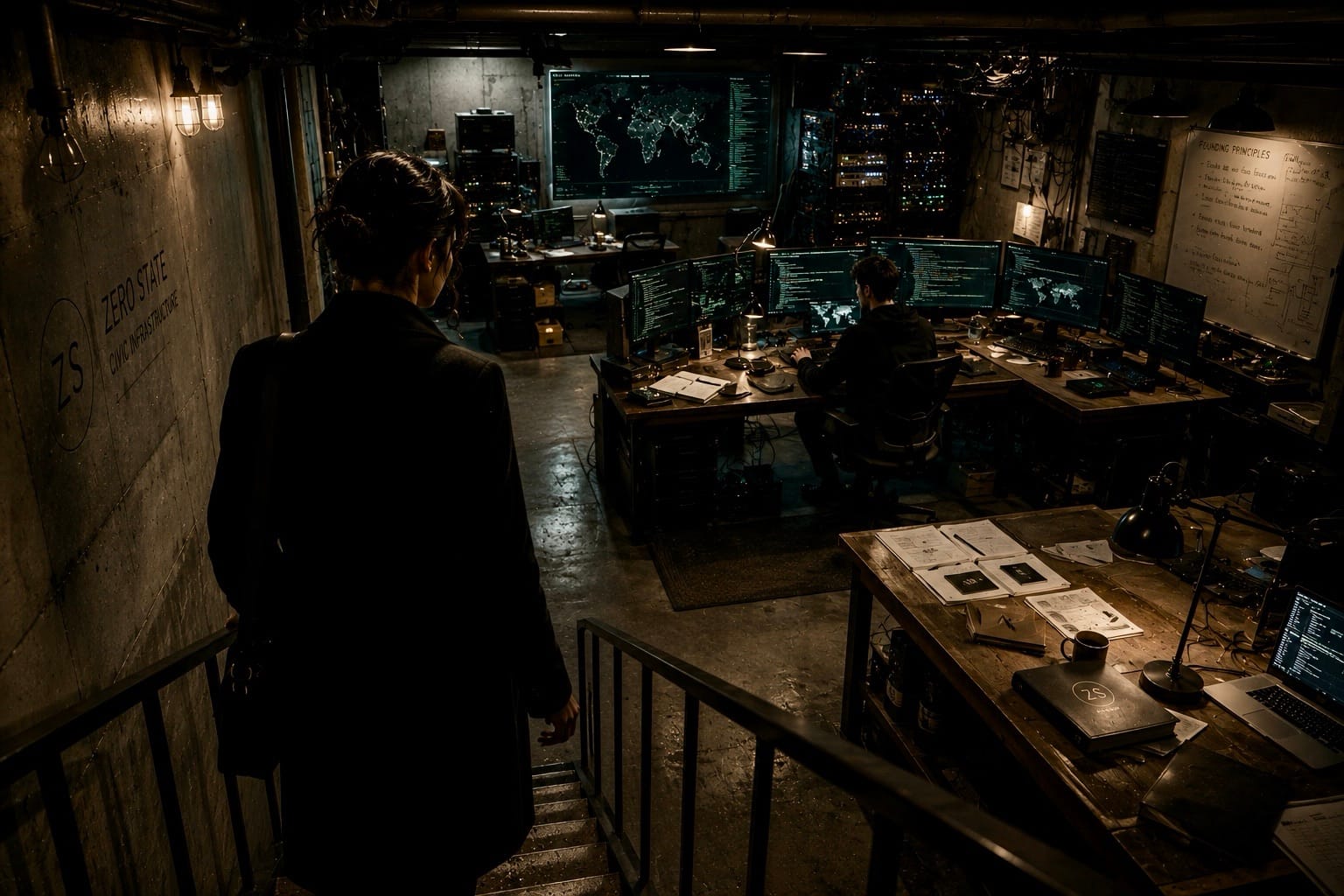
The space beneath the coffee shop had not been used in years. Dust had settled into the corners with the patience of something that expected to stay. The drywall bore the scars of repairs that had been started and quietly abandoned, and a projector screen sagged against the far wall as though it had given up on being horizontal.
But the smell had changed.
Burnt circuitry. The faint drift of caramel from the kitchen upstairs. The particular warmth of machines that had been running too long and too hard.
Liam had struck a deal with the café owner and had been outfitting the space over the weekend. Cables ran along the baseboards and up the walls in organized lines. Three monitors sat on a workbench built from lumber and clamps, each displaying a different layer of the same running model. Routers hummed steadily in a rack he’d bolted to the wall himself.
It looked less like a workspace than the inside of a decision.
Bill Harroway stepped through the door and stopped.
Liam was at the far wall, a drill in one hand, a router bracket half-mounted above him. He hadn’t heard Bill come in, or if he had, he hadn’t considered it worth turning around for yet.
Bill stood quietly and took the room in properly.
Four laptops open on the side table, each running something different. The three monitors on the workbench cycling through layers of the same model. A whiteboard covered edge to edge in a handwriting so small it required moving closer to read. The machines had clearly been running all night — the particular warmth of a room that hadn’t been dark in days.
He had spent forty years watching governments fail to build things this organized.
His hand went to his briefcase. The same instinct as the café — and the same answer. His laptop hadn’t left the bag since the morning Liam had pointed that out without pointing it out.
He set the briefcase down and left it there.
“This,” he said, “is more than I expected.”
Liam glanced back without turning fully. “I had some time.”
It wasn’t modesty and it wasn’t a boast. Just a simple accounting of how the work had gotten done. And Bill understood, standing in that basement, that the doubt he’d carried down the stairs — one man can’t possibly do the work of government — had already been answered before he’d said it aloud.
❧
The Portfolio
Bill set a thick folder on the steel chair beside the workbench.
“Before we go further,” he said, “I want you to meet someone. She won’t flatter you. She won’t tell you the work is good unless she believes it. And she will find every place your model breaks before she says anything else.”
Liam looked up from the screen. “Who is she?”
Bill slid the folder forward without answering.
The tab read: MARIS ALBRECHT.
Liam opened it and went quiet. Bill watched him read — the slight slowing of his eyes on certain lines, the stillness that came over him the way it does when something genuinely lands.
The file documented predictive modeling work across three administrations. Infrastructure recovery plans that had never made the news because they hadn’t needed to. Crisis simulations run quietly before the crises arrived. The kind of record that doesn’t get publicized because the people who commission it prefer that no one ask how it was done.
“She’s good,” Liam said.
“She’s better than good,” Bill said. “And she’ll know within an hour whether what you’ve built holds up or whether it just looks like it does.”
Liam closed the folder and set it down. He didn’t say anything for a moment, which Bill had already learned to read as the equivalent of agreement.
“When?” Liam asked.
“Two nights.”
❧
Her Arrival
Maris Albrecht came down the stairs with the particular caution of someone who had agreed to something they weren’t entirely sure about yet.
Bill had called her on a Tuesday. She’d heard about his firing on a Wednesday — from someone who hadn’t known she knew Bill, which meant it was already moving through the right rooms. She had taken the meeting anyway, because Bill Harroway desperate was still Bill Harroway, and that was worth an evening.
But she had expected grabbed-at straws. She had expected a whiteboard with arrows and someone else’s ideas written in marker.
She stopped at the bottom of the stairs.
The network rack along the wall was enterprise grade. The monitors were running three simultaneous model layers, each one live. The cables were organized with the kind of discipline that didn’t come from enthusiasm — it came from someone who had built things before and knew what a poorly run cable would cost at three in the morning.
This wasn’t a hacker on a PC. This was infrastructure.
In an unfinished basement beneath a coffee shop.
She looked then at Bill, who was watching her with the expression of a man waiting for a verdict. And she understood something immediately — whatever this was, it wasn’t Bill’s. He was here the same way she was here. Because someone had made it impossible not to come.
She did not look at Liam immediately.
Liam noticed this, and noticed also that he had expected her to.
He returned his attention to the screen and told himself it was because she was reading the work first. Which was true. It was also not the only reason he had been watching the stairs.
She stood in front of the central monitor for five full minutes without speaking. Bill sat in the corner and waited. Liam kept his eyes on his own screen and got considerably less done than usual.
Finally, Maris said: “You’ve built a working model of a democratic process.”
No approval in it. No criticism. Just a precise description of what she was looking at.
“Still building, but yes, that’s the intent,” Liam said.
She pulled the spare chair forward and sat down. “Walk me through the resource allocation layer.”
Up close, she was more composed than she had seemed from across the room — not cold exactly, but contained, like someone who had decided long ago which parts of herself were relevant to the work and kept the rest elsewhere. Liam found this easier to be around than warmth would have been. Warmth would have been distracting.
He opened a flood-response simulation and walked her through it steadily, the way he always explained things — not performing clarity but simply being clear.
❧
The Test
Maris leaned toward the screen, following each branch of the model with the focused attention of someone who had watched real systems fail.
At some point she leaned further in to read a variable string. Her jacket shifted. A button below the collar came loose.
Liam reached for his coffee cup.
It had been empty for twenty minutes. He took it anyway, and in the half-second it bought him his eyes moved where they were going to move regardless.
He set the cup down.
Maris, without turning, said: “The latency on the triage fork — is that deliberate?”
“Yes,” Liam said. “It allows for a human confirmation step before an automated resource dispatch.”
“Good,” she said. And leaned back.
She had not reached to fix the button. She didn’t intend to. There was nothing to see and she knew that, which meant the information she had just gathered cost her nothing and might someday be worth something.
She filed it away the way she filed everything — without ceremony, without conclusion. Just a data point, sitting quietly alongside all the others.
They worked through the night.
Maris ran the model through scenarios with a methodical patience that Liam found himself respecting more as the hours passed. Not single crises but compounding ones — a supply chain collapse deepened by a simultaneous communications failure, a natural disaster layered over a disputed election, a blackout during a civic vote. The kinds of situations that didn’t happen in sequence but all at once, and that legacy governments had historically handled by slowing down and forming committees.
Liam’s model didn’t slow down. It triaged, redistributed, and documented in real time.
He had built it that way deliberately, though explaining exactly why would have taken longer than simply showing her. So he showed her.
Occasionally Maris would ask a question — precise, without preamble — and Liam would answer it the same way. There was an efficiency to working beside her that he hadn’t expected and didn’t quite want to examine. She made the room feel smaller in a way that wasn’t unpleasant.
He focused on the work.
By the early hours of the morning, Maris sat back and was quiet for a moment.
“The model holds,” she said. “The stress points are in the human interface layer, not the logic. That’s fixable.”
She looked at Bill. “You’ll need three more people to build this into something real. Someone from defense — not a bureaucrat, someone who has actually operated in the field. A financier who understands both large-scale capital and why it goes wrong. And an independent oversight voice. Someone whose job is to ask what happens after.”
Bill nodded slowly. “And you?”
“I’m the latter,” Maris said. “I’ll watch it all. I’m in.”
She stood and straightened her jacket, her expression unchanged from the moment she had arrived. Then she glanced at Liam with something that was not quite a smile and not quite its absence.
“He’ll need more support than he thinks,” she said to Bill, without looking away from Liam. “The work is sustainable. Whether he is remains to be seen.”
“I’m fine,” Liam said.
Maris held his gaze for one beat longer than necessary, then looked away. “I’m sure you are.”
She said it without irony. Which somehow made it land with more.
❧
Zero Minutes
Bill stood at the center of the room, looking at the monitors. The light from the screens reflected in the lenses of his glasses.
“Incredible. Is this what I think it is?”
It wasn’t a question.
Liam watched him from the workbench.
“This isn’t a video game,” Bill stepped closer and continued. “You’re building a government.”
Bill pointed at the monitor. “These are citizens participating in decisions.”
Liam said nothing — fully aware that Bill was watching forty years of experience organized into keystrokes.
“No inherited procedures. No legislation that takes three years and a thousand pages to move six inches.” Bill turned toward the screens. “How fast could a decision move through a system like this? A real decision. An emergency response for example.”
Liam thought about it honestly rather than quickly. “Depends on the decision. But bottlenecks in legacy systems aren’t structural — they’re political. Remove those and you’re talking minutes instead of months. Possibly no minutes.”
“Zero minutes,” Bill said quietly. Almost to himself.
He set a hand briefly on Liam’s shoulder — the gesture of a man who had spent decades knowing when something mattered — and then stepped back.
“The build starts now.”
Liam turned back to the monitors. He didn’t feel the weight of the moment the way Bill seemed to. He just felt what he always felt when a problem worth solving involved a keystroke.
❧
Across the room, Maris gathered her coat and looked at the screens one last time.
She had spent her career predicting outcomes — building models to show governments what was coming before it arrived. She was good at it.
What she had not predicted was him — the particular combination of ability and openness that made Liam Rourke both the most capable person in the room and, she suspected, the most persuadable.
She filed that away.
In her experience, the most useful people were never the ruthless ones. They were the ones who believed, genuinely, that the people around them shared their intentions. Liam Rourke believed that. She could see it in the way he worked — certain that ability was enough protection.
It wasn’t. But he didn’t need to know that yet.
She went upstairs.
❧