The countdown…Week 10
Bill Harroway had spent forty years shaping governments.
It took one morning to remove him from one, and a stranger in a rainstorm to give him something back.
❧
The Coffee Shop
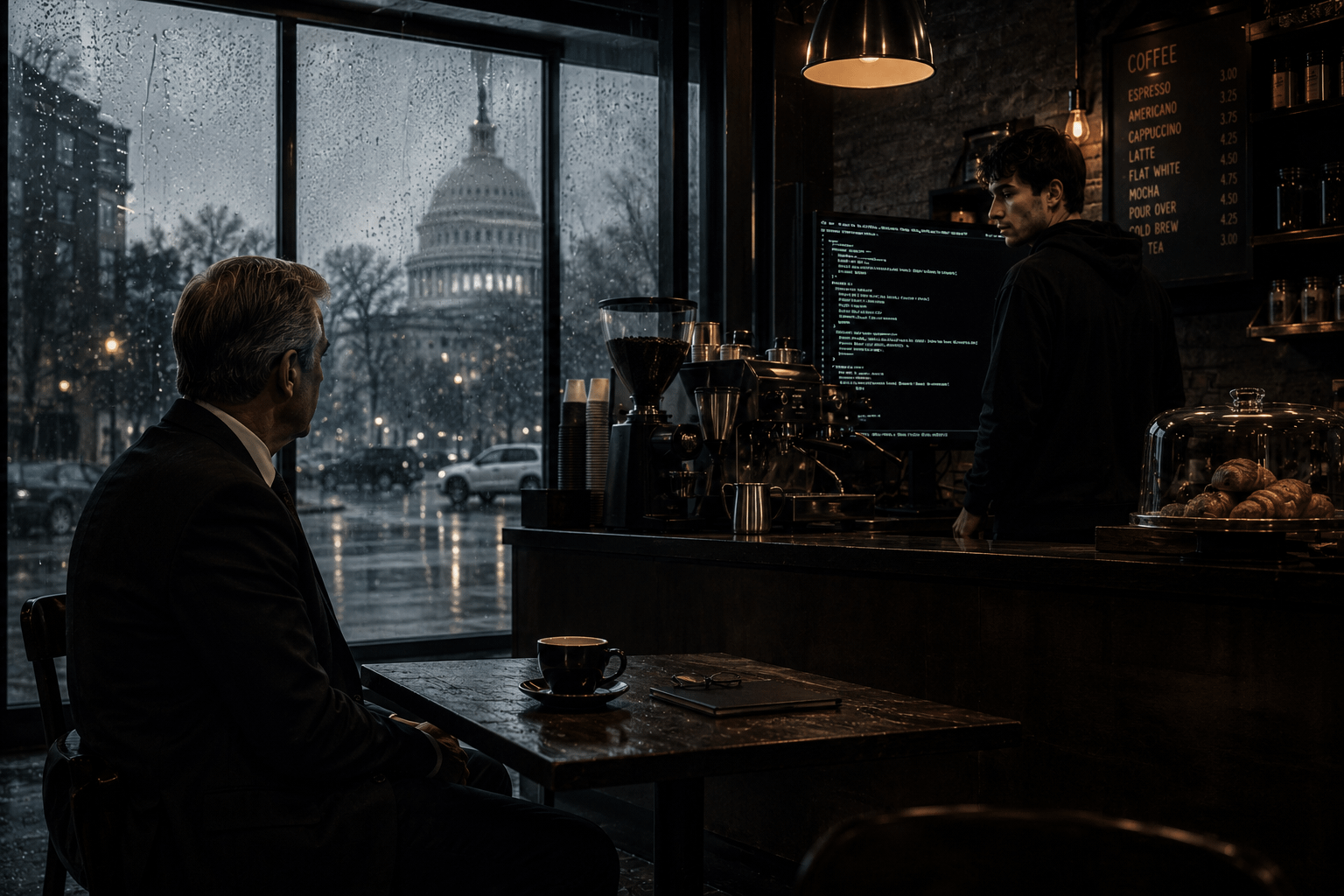
The rain came sideways that afternoon, cutting across Washington in sheets that turned the Capitol into a pale suggestion behind fogged glass.
Inside the coffee shop, the weather was its own kind. Steam curled from machines along the counter, grinders ran in short, punctuating bursts, and laptops threw small islands of light across crowded tables. The room carried the particular energy of people who believed they were moving forward — and Bill Harroway, sitting alone in the corner, the only one who wasn’t sure he agreed.
The email had been one sentence. No meeting, no phone call, no warning. Forty years had been reduced to language polite enough to be ignored and final enough to end everything.
He had not told his children. He had not told his colleagues. He had not yet found a way to tell himself.
The suit still fit him in the shoulders. The rest of him had not caught up. He folded the paper napkin in front of him, smoothed it flat, and folded it again — not out of habit, but out of the need to do something that responded to his hands.
He was not accustomed to nothing.
His gaze drifted across the room without purpose, and then stilled.
Behind the espresso machine, a black screen pulsed with silver text — clean, rapid lines that built on themselves without pause. A green cursor blinked at the end of each sequence, patient and expectant, as though it was waiting for a question no one had yet thought to ask.
Bill watched it longer than he intended to.
❧
The Barista
“My boss lets me code when it’s slow. That’s why the monitor’s there.”
Bill looked up. The barista was younger than the voice suggested — mid-twenties, dark-haired, with pale green eyes.
“Are you building something now?” Bill said, noticing the text filling the screen.
“I guess you could say I’m never not building something.”
“Like a video game?”
“You could call it that.”
“What would you call it?”
Liam paused and looked over his shoulder. Bill’s eyes followed to the monitor with him.
Liam noticed, and then said, “A new society.”
Bill smiled. Then he read Liam’s expression. Confidence, not arrogance. He didn’t even blink.
The smile faded.
“Well,” Bill said. “You should have it complete in about 250 years.”
“I’m thinking more like 10 weeks.”
Bill looked down at the cup that had appeared beside him — a flat white, placed without asking, while he’d been watching the screen.
“You look like you used to be important,” the young man said.
“I’m sorry?”
“The suit in a coffee shop at 2pm. The fact that you haven’t opened a laptop in two hours.” A brief pause. “People who are still important don’t sit that way.”
Bill found himself waiting for what came next.
“Unless they’re looking for their next step.”
He was not offended, which surprised him. “And what step is that?”
Liam finished wiping down the counter. “Like they’re waiting for permission.”
Bill said nothing. There was nothing useful to say.
“I didn’t order this,” he said finally, nodding toward the drink.
“You didn’t,” Liam replied. “But you stayed. That usually means something.”
“Does it.”
“Most people who’ve had a bad morning leave. You didn’t.” He shrugged once. “So I figured you might as well have something warm while you decide what comes next.”
Bill looked at the cup, then back at him. No performance in it. No bid for a larger tip. Just a quiet, unassuming accuracy that was somehow more unsettling than arrogance would have been.
“Thank you,” Bill said. And meant it.
❧
The Spark
Liam returned to the machine, and for a few minutes the conversation seemed finished. Bill drank slowly, watching the rain rearrange itself against the glass.
At some point his hand moved to his briefcase. Habit. The same reach he’d made a thousand times in a thousand rooms — for the laptop, for the next thing, for the work that was always waiting.
His hand rested on the clasp.
He hadn’t opened it once.
“One mistake,” he said. Not directing it at anyone in particular. “That’s all it takes.”
He hadn’t intended to say it aloud. But the room seemed to invite it.
Liam glanced over without moving closer.
Bill continued, more quietly now. “One attachment. One document forwarded to the wrong inbox at the wrong time, by someone who wasn’t careful. And the room you’ve spent your life in simply closes.” He paused. “No one even calls.”
Liam said nothing immediately. Behind him the grinder ran a short burst and went quiet.
“What did you lose?” he asked finally.
Bill considered the word for a moment before he found the honest one.
“My relevance.”
It sounded smaller than he expected. And heavier.
Liam nodded slowly. Not performing sympathy. Just receiving it.
“I’ve read your work,” he said.
Bill looked at him directly for the first time. “That’s not something people say casually.”
“It isn’t,” Liam agreed.
A brief silence.
“I’m ready. Share an opinion,” Bill said.
Liam was quiet for a moment — actually thinking, not performing consideration.
“The infrastructure amendments from 2019,” he said. “The funding was sound. But the implementation timeline assumed the people building it had the same incentive as the people who wrote it. They didn’t.”
Bill was still.
“That’s a specific critique,” he said.
“One a scale of 1 to 10, how right am I?”
Bill studied him. Not the screen now — the young man himself. “You read legislation to understand why things stall.”
“Technically my machines read it,” Liam said with a slight nod to the monitor. He set down the cloth he’d been folding. “It’s the same conclusion every time. The gap between when something is needed and when it happens. That’s not a political problem.” He paused. “It’s a systems problem.”
❧
The Blueprint in a Hoodie
Bill leaned forward slightly, the way he had leaned toward people in rooms where things actually mattered.
“What would you change first?” he asked.
Liam didn’t answer immediately. He looked at the screen, then back at Bill.
“The distance between a problem and its solution,” he said. “It’s artificial. Every system I’ve looked at — built to protect itself, not the people inside it. It doesn’t have to work that way.”
The thunder outside moved through the city — low, unhurried, without apology.
Bill straightened slowly.
He had sat across from senators and undersecretaries and appointed officials who spoke for a living. Very few of them had said anything that felt like that. Like something reasoned through rather than rehearsed.
“You know what happens to people who build systems like that,” Bill said.
“Usually they don’t get adopted,” Liam agreed.
“Then—”
“They get built anyway.” He picked up the cloth again, folded it once, set it down. “And eventually something replaces what can’t keep up.”
Bill sat with that.
Then he picked up the flat white and drank, and set it down carefully.
“You shouldn’t be building it alone,” he said.
Liam looked at him the way someone looks at a conclusion they’ve already considered.
“Probably not,” he said.
Bill’s hand still rested on the briefcase clasp.
He didn’t open it.
Outside the rain pressed on. Inside, the green cursor blinked against the black screen — patient, unhurried— waiting for the next line of something that did not yet have a name.
❧