✥ Chamber Tale XXIV
By the time Evelyn reached the farmhouse, the afternoon heat had settled over the fields.
Corn stood high along both sides of the county road, its leaves dusty and curled at the edges.
Beyond it, the farmhouse sat beneath two old maples, white paint thinning on the southern wall.
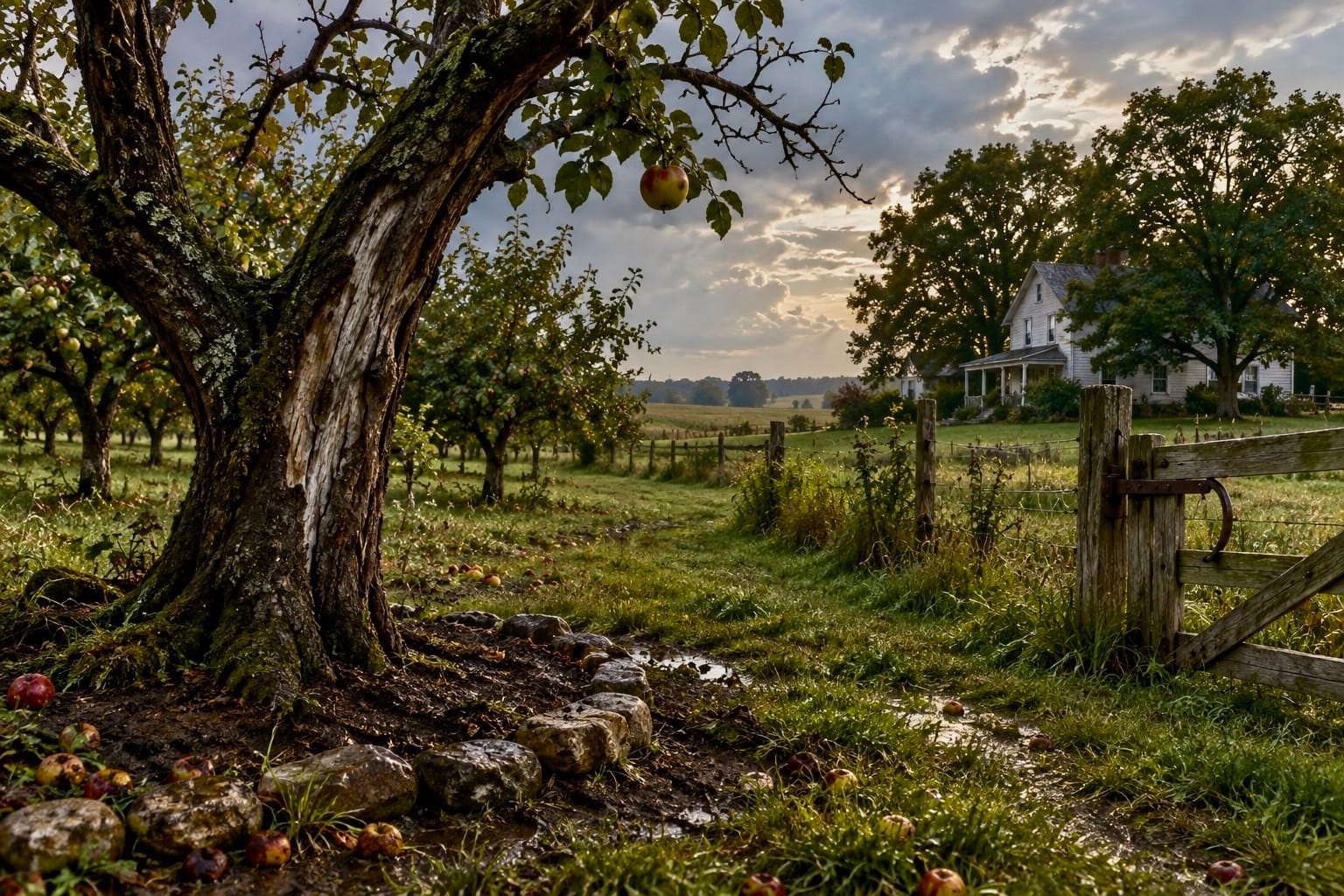
A small orchard stretched behind the house, no more than twenty trees arranged in uneven rows.
Her aunt was waiting on the porch.
✥
She took Evelyn’s suitcase before Evelyn could object.
“I can carry that.”
“Yes. I know you can.” Her aunt carried it inside and up the stairs to the bedroom Evelyn used on visits.
The house was plain and cooler than outside, its rooms narrow and taller than Evelyn remembered. Floorboards showed pale paths where generations of feet had worn away the finish.
Forged iron latches remained on several of the doors, blackened by years of hands. A mason had made them long ago, along with the heavy latch on the orchard gate. Evelyn had heard the story as a girl but could no longer remember his name.
Two oil lamps stood on the kitchen windowsill despite the electric fixture hanging above the table.
Her aunt noticed her looking at them. “The power goes out.”
Evelyn nodded.
Nothing more was said.
✥
The next morning, Evelyn followed her aunt into the orchard.
Most of the trees were older than Evelyn, their trunks thick and irregular, planted in rows that had lost some of their original order as trees died and others were replaced.
Grass grew high around the fence posts, and fallen apples lay beneath the branches with yellow jackets working at the split fruit.
The healthier trees were heavy with late-summer apples, some of their branches supported by narrow boards driven into the earth.
One tree near the northern edge was noticeably different.
Unlike the others, its trunk leaned toward the field. Bark had separated along one side, revealing a long grey scar. Several upper branches were bare, and those leaves that remained had curled inward.
Evelyn stopped beneath it.
“This one’s dying.”
Her aunt set down the basket she was carrying. “It is.”
“Why haven’t you cut it down?”
Her aunt looked at the tree for a while. “It isn’t finished.”
She walked on.
Evelyn looked once more at the dead branches before following.
✥
They worked there after breakfast the next day.
Her aunt brought a shovel, pruning shears, a bucket of compost and a small iron bar. She gave Evelyn the shears.
Her aunt pointed toward two dead branches.
“Okay.” Evelyn cut the first easily. The second was thicker, and she had to brace herself.
Her aunt reached over and took the shears.
“I can do it.”
“Yes. I know you can.” It was the second time she had said it.
Evelyn stepped aside.
Her aunt placed one hand against the trunk. She stood that way for several seconds, looking upward through the branches before moving the shears lower.
She cut a different branch.
“What about the dead one?”
“We’ll worry about it later.”
There was no explanation.
✥
They loosened the packed earth around the roots and worked compost into it. Along the uphill side, her aunt began placing fieldstones in a shallow curve.
Evelyn watched her. “What are those for?”
“The water’s been running the wrong way.”
“The ground’s dry.”
“Today.”
Evelyn looked toward the sky. There wasn’t a cloud anywhere she could see.
Her aunt handed her a stone.
By noon, they had built a low channel around the upper roots.
✥
That afternoon, they sat at the kitchen table snapping beans into a yellow bowl.
Evelyn had been at the farmhouse four days. Her aunt had not asked why.
“He wrote once,” Evelyn said.
Her aunt broke the end from another bean.
“Said he needed time.”
The pieces dropped into the bowl.
“I suppose I’ve given him plenty.”
Her aunt pushed the bowl toward the center of the table and reached for another handful.
Evelyn rested both hands beneath the table. “I don’t know how I’m supposed to do this.”
Her aunt looked at her then.
Evelyn swallowed. “I’ve thought about finding someone who could give it more.”
Outside, cicadas filled the trees with their dry, relentless sound.
Her aunt snapped another bean.
Evelyn sat straighter. “There are families who can’t have children.”
“Yes.”
“Good families.”
“Yes. I know.” Her aunt nodded.
Evelyn looked toward the window. “What would you do?”
Her aunt’s hands stopped.
For a moment Evelyn thought she might finally receive the answer she had come there hoping someone would give her.
Instead, her aunt picked up another bean. “It isn’t mine.”
They finished the bowl together.
✥
Before supper, her aunt went outside and brought the washing in.
Evelyn watched from the porch. “Are you expecting company?”
“I’m expecting rain.”
Evelyn looked across miles of clear western sky. “Tonight?”
Her aunt folded a sheet over her arm. “Before morning.”
She carried the basket inside.
✥
Near midnight, Evelyn woke to thunder.
Rain struck the roof hard enough to shake loose dust from the window screen. She went downstairs and found one of the oil lamps burning on the kitchen table.
Her aunt was outside.
Through the rain-streaked window, Evelyn could see her moving through the orchard with the lamp in one hand.
The following morning, water stood between the rows.
At the damaged tree, the little channel of stones had caught the runoff and carried most of it around the exposed roots.
Her aunt crouched and pushed one displaced stone back into place.
Evelyn did not ask how she had known.
✥
That evening they made a pie.
Her aunt peeled the apples in long curling strips while Evelyn rolled the dough across the floured table.
She had almost managed a circle when the crust caught beneath the rolling pin and tore through the middle.
“Oh, damn it.”
Her aunt glanced over.
Evelyn lifted the ruined dough.
“Leave it.”
“It looks terrible.”
“It will be fine, Evelyn.”
Evelyn looked at the tear.
Her aunt wiped her fingers on her apron, pressed one side of the dough together with her thumb, then turned the board toward Evelyn.
Evelyn patched the other side.
They fitted it into the tin. The repaired places remained visible beneath the apples.
After supper they ate the pie warm.
The crust held.
✥
On Evelyn’s last morning, they walked to the northern edge of the orchard.
The damaged tree looked much as it had when she arrived. Its trunk still leaned. The scar remained open. Several branches were gone now, leaving gaps through which the morning sky showed blue.
Her aunt stopped beneath it. “There.”
Evelyn followed her gaze.
Hidden among the leaves was a single apple, small and mottled yellow-green.
“You left that?”
“It needed time.” Her aunt reached up and turned it once in her hand.
The apple came free.
At the kitchen steps, she cut it in half with a paring knife and handed one piece to Evelyn.
It was tart and still a little hard.
They ate it anyway.
✥
The bus came shortly after ten.
Her aunt carried Evelyn’s suitcase as far as the road and set it beside her.
Evelyn hugged her.
Neither woman said anything about the baby.
✥
When the bus disappeared beyond the cornfields, her aunt returned to the kitchen. She washed the knife, wiped the table and put away the two cups they had used that morning.
An envelope remained beside the sugar bowl.
She picked it up.
It had arrived the week before and had been forwarded twice before finding the farmhouse.
Miss Evelyn Howe
Her aunt carried it upstairs and placed it on the guest bed beside the hair bow Evelyn had forgotten to pack.
Then she went downstairs and back outside.
✥
The iron latch lifted heavily beneath her hand.
She closed the orchard gate behind her and walked toward the northern row.
The stones were still where they had placed them. The earth beneath the tree was dark from the rain. Its scar had not closed, and the missing branches would never return.
Her aunt rested her palm against the trunk.
Then she removed her hand and walked on.
The tree lived another forty-three years.
✥
This door closes quietly.