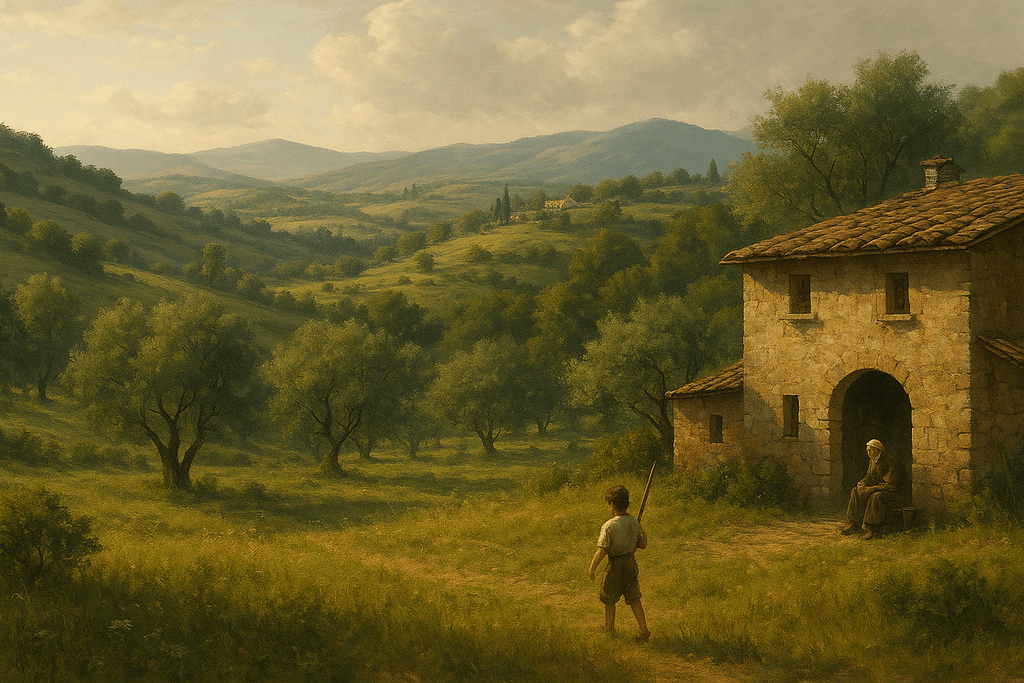
Nico ran the orchard paths as though they had been laid out for him alone.
Dry grass cracked beneath his feet as he cut between the twisted trees, following routes he had traced a hundred times before. The branches hung low with hard green fruit that would sweeten in the weeks to come, but he moved too quickly to notice them. In his mind, the orchard was no longer rows of trees and dust.
It was a field.
A road.
A place where something waited to be tested.
He gripped his pike with both hands.
It was a crude length of shaved oak, its tip dulled and re-carved so many times that the grain had begun to splinter near the end. The shaft was longer than he was tall and poorly balanced, but Nico held it as though it belonged to him.
As though it made him something more.
He swung it in a wide arc, stepping through the motion the way he had seen older boys do in the square. His feet slipped on exposed roots, then caught again. He adjusted, corrected, and drove forward.
A thrust into empty air.
Dust lifted in a tight ring around him.
He imagined the impact.
Held it there for a moment.
Then pulled back and moved again.
❧
Familia
At the far edge of the orchard, Donato stood beside the low stone wall that marked the boundary of the property.
His shoulders curved beneath a patched doublet the color of late pears. A needle case and shears hung from his belt, tapping softly against his hip when he shifted his weight. His fingers twitched now and then, as though they still worked thread through cloth, but his attention remained fixed on the boy moving through the trees.
A faint smile touched his mouth before settling into something quieter.
Nico had lengthened this spring. The change had come quickly—too quickly. Limbs that had once belonged to a child now moved with a reach that had not yet learned restraint.
Donato had seen boys like this before.
Boys who carried sticks as though they were steel. Boys who practiced alone, not because they were told to, but because something in them insisted.
They learned quickly.
They left quickly.
Some did not return at all.
Near the cottage, Marietta’s voice drifted through the warm air as she called Nico in for supper. Her laughter followed the words, light and easy, as though nothing in the world had ever required guarding.
The sound reached Nico’s right ear clearly—bright, familiar, alive.
On his left side, there was only the hush.
The quiet had been with him for as long as he could remember. It did not trouble him. If anything, it gave the world a shape he understood: one side filled with voices and movement, the other settled into a steady calm.
Sometimes he wondered if everyone lived that way and simply never spoke of it.
He did not mind it.
Not yet.
At last, his pace slowed. Nico planted the butt of the pike into the dirt and leaned against it, breathing hard as though he had finished something real. The wood was warm beneath his palm.
When he saw Donato watching from the wall, he straightened and lifted the pike in a small, triumphant salute.
Donato returned the gesture, though his hand rose more slowly.
Nico grinned, bright and certain, and turned toward the cottage. He ran again, cutting between the trees until he disappeared beneath the low archway.
Donato remained where he was.
He watched the space the boy had left behind longer than he intended, as though something of Nico still moved there, just out of sight.
Only when the orchard settled back into stillness did he exhale.
His hand rose to his shoulder, pressing into the place where the ache never fully left. The memory of it had outlasted the wound itself.
“Ah, ragazzo,” he murmured, the words carried no farther than the wall.
“Play while you can.”
His gaze shifted toward the path beyond the orchard—the one that led toward the road, and beyond it, the towns that had begun asking more of their sons each year.
“The world will not be this orchard forever.”
For a moment, he stood without moving, as though weighing whether the thought should have been spoken at all.
Then he turned toward his workshop, following the familiar scent of oil and wool.
Behind him, the orchard remained golden in the lowering light.
Quiet.
Unchanged.
And already, he knew, beginning to lose him.
❧
We thank our founder for his support.