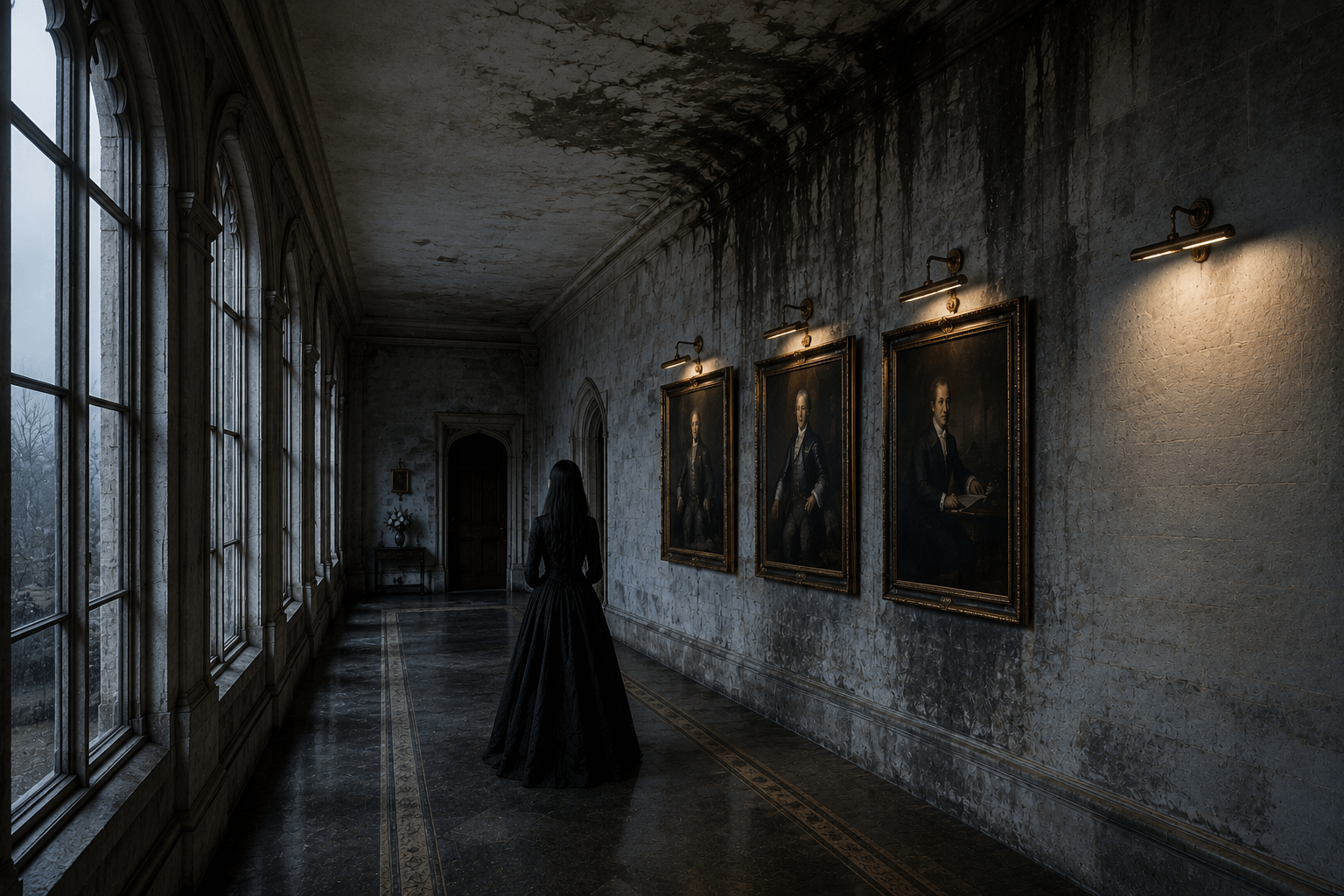
✥ Chamber Tale XX
Catherine Vale had been thirty-five for longer than the village had possessed a church.
No one living knew this. To those who glimpsed her beyond the iron gates, she was simply the last mistress of a declining estate—a solitary woman with enough money to keep the roof from failing and enough pride to avoid the village below.
Supplies came to the gatehouse. Servants changed with the years.
Catherine did not.
✥
Her hair fell long and black over one shoulder. Her lips were the only color she allowed herself. She had learned that people remembered the red and neglected to ask questions about the rest.
In the autumn of 1887, rain found a weakness in the east gallery roof, and her steward sent for an architect from the city.
His name was William King.
Catherine dismissed the steward, then watched from the drawing-room window as a hired carriage climbed the approach. A young man stepped down with a leather case in one hand. He paused before the house and looked up—not at the windows, but along the roofline, measuring the damage before anyone had shown it to him.
Catherine pressed her fingers to the glass.
Not the coat. Not the beard. The face. The same broad brow, the same habit of lifting his eyes to judge a structure’s strength.
“Not yet,” she whispered.
But he was already knocking.
✥
William had expected an elderly widow. The woman who received him could not have been much older than himself.
“Mr. King.”
“Miss Vale?”
“Catherine.”
When she offered her hand, something crossed her face the moment their fingers touched.
Recognition.
“Have we met?”
“No.” She answered too quickly, then smiled. “But this house has a way of making strangers seem familiar.”
She led him up through the west hall to the gallery, where three portraits hung beneath the water-stained ceiling.
An armored man with a sword. A gentleman in a powdered wig. A young man at a writing desk, his expression gentler than the others—almost amused.
William stopped before the third.
The man had his eyes. Not merely the shape or color, but the exact look he had seen in mirrors while listening to someone he loved.
“Who are they?”
Catherine turned to look at the portraits as well. “Men who came to help me.”
“Were they related?”
“Not in the way you mean.” Her gaze rested on the third portrait, and something moved beneath her affection that William felt.
✥
He stayed to repair the roof, and stayed longer than the roof required.
Catherine understood the manor the way no plan could show—which corridors carried what sounds, which floors settled in the rain.
When he asked how she’d learned so much, she said only that the house had been hers a long time.
He mistook it for sentiment.
✥
Their intimacy grew: a hand at his back crossing a weakened floor, her head against his shoulder by the fire, the way she watched for him to enter a room as though relieved each time he did.
The first time he kissed her, she held his face in both hands and returned it with a grief so deep he felt it before he understood it.
“You still close your eyes,” she whispered afterward.
“When I kiss you?”
She drew back. The warmth left her face.
“You should leave when the gallery is finished.”
“Is that what you want?”
“No.” The word came with more force than anything else she’d said. “That is precisely why you must.”
✥
The storm broke after midnight, two weeks later. A tree branch shattered the drawing-room window, and as Catherine reached across the table, William caught her arm and pulled her back—her hair swinging clear of her shoulder.
The scar began beneath her collarbone and spread over the curve of her shoulder, pale and uneven, as though flame had once rested there long enough to leave its handprint.
She covered it at once.
“How did it happen?”
“A man tried to save me.”
William thought of the portraits. “How long ago?”
“Long enough.”
He crossed the room and lifted her hair gently away from the scar. She did not retreat.
“You don’t need to hide it from me.”
Her lips parted. Something fierce and tender crossed her face.
“You said that before.”
His hand stilled. “Before?”
Catherine looked past him, down the darkened hall, to where three painted faces waited in the gallery beyond the reach of the firelight.
She drew her hair back over the scar.
“You should sleep,” she said, and left him standing at the broken window.
✥
William found her in the gallery, standing before the three portraits as though she had been waiting for him to come find her there instead.
He did not raise his voice. He only asked how many times.
Catherine did not look away from the paintings. “They had come to help me,” she said.
“Each time I had fallen in love.”
She told him the rest. She told William she had been convinced that something beyond the safety of the estate would take him from her.
She had made a decision meant to keep him safe.
A locked gate. A delayed journey. A pistol fired to stop a frightened horse.
She had believed, every time, that she was saving him.
“And every time,” William said, “he died.”
“Yes.”
She said it the way she might confirm a date, or the weather. Not proudly. Not defensively.
Simply as fact.
“You’re telling me you killed them.”
“I’m telling you I loved them enough to be certain I knew better than what was coming for them.”
✥
She turned from the portraits at last. “I have had two hundred years to improve my judgment. I believed, every time, that this was the year I finally had.”
William looked at the third portrait, the young man at the writing desk, and understood for the first time why his expression had always seemed gentle rather than at peace.
“And now?”
Catherine’s answer came without hesitation, which was somehow worse than if she had needed to consider it.
“I believe it again.”
✥
William left before dawn, the ledger pages still open on the desk behind him.
He did not take the manor’s carriage.
He walked the four miles to the village and paid a boy to wake the stationmaster early, and by the time the sky had gone the color of ash he was standing on the platform with his case in one hand, waiting for the northbound train that would take him back to the city and away from every name written in that ledger.
Catherine arrived as the train was already moving.
She did not call out. She had read the schedule the moment she found his room empty, and she knew which bridge the northbound line crossed forty minutes past the village, and she knew what the sky had looked like every year it rained like this.
She took the road instead of the rail, the shorter way, the way only someone who had lived in that country for two hundred years would think to take.
✥
She reached the bridge before the train did.
The keeper’s hut stood at the near end, and inside it a single lever controlled the signal that would either let the train cross or hold it at the siding until the wind eased.
Catherine had never touched the lever in her life. She had spent lifetime after lifetime learning exactly this kind of mechanism, and she had promised herself, standing in this same doorway once before, that she would never touch one again.
✥
The wind came off the river in long, cold pushes.
Somewhere beyond the bend she could hear the train.
She could let it come.
She could stand in the storm and let the bridge do whatever a bridge does in weather like this, and either it would hold or it would not, and either way it would not be her hand that decided it.
Or she could pull the lever and hold the train at the siding for ten minutes, long enough for the worst of the gusts to pass.
She thought of the writing desk. The powdered wig. The sword.
And pulled the lever.
The train slowed, then stopped, exactly as it should have.
It was the coupling that failed. Not the bridge, but an iron pin worn thin by years of ordinary use.
The forward carriages went on without the rest.
William’s carriage did not.
Catherine’s hand never left the lever.
Far below, something struck iron.
The rain continued until evening.
✥
Winter passed.
A portrait arrived at the manor. No one could say who had painted it, or when.
It showed William standing in the east gallery, plans beneath one arm, the ceiling above him whole.
His expression was peaceful.
Catherine hung it beside the other three.
She touched the frame once.
✥
Years later, another letter arrived.
It was signed by a young architect named George King.
Catherine closed her eyes before breaking the seal.
She already knew where he would sleep.
✥
This door closes quietly.