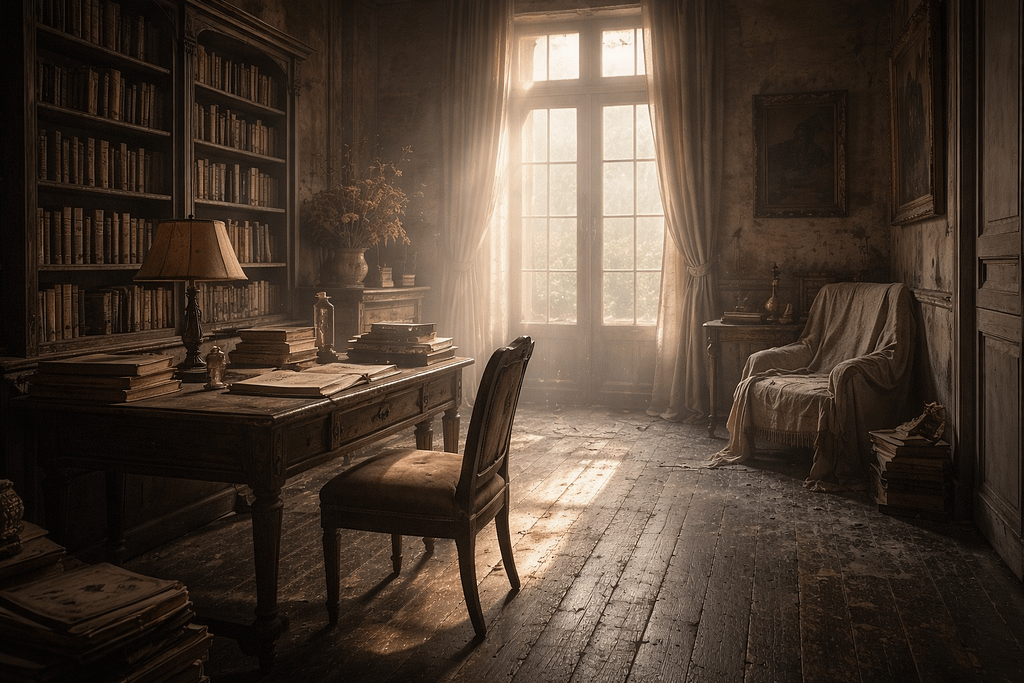
through the fog


Very few journeys begin with the end in sight.

Most begin with uncertainty—
with partial information, imperfect data, and a path that disappears just a few steps ahead.

And still, we go.

You do not need to see the whole road to begin walking it.
You only need enough light for the step in front of you.

Clarity is rarely granted in advance.
It is earned—slowly—through motion.

One step.
One breath.
One decision made without guarantees.

Those who wait for perfect certainty often remain where they are,
mistaking caution for wisdom.

Those who move accept a quieter truth:
the fog does not lift all at once.

It recedes only as you pass through it.

And sometimes, the act of stepping forward
is not reckless—

it is how others learn the way.


Before the decision. Before the certainty. He walked the path anyway.


The Conservatory grows quiet again.

If this letter found you at the right moment,
you are welcome to wander further in the Castle.


your room


Somewhere beyond the noise, there is a room that remembers you.

It does not accuse you of leaving.

It does not resent the years you passed it by, convinced it no longer mattered.

It simply remained—unchanged in purpose, waiting for the moment you would finally be able to enter it honestly.

Everyone has a room like this.

A conversation never begun.

A truth set aside because the cost felt too high.

A way of living that once seemed impractical, idealistic, or impossible.

Time does not erase these rooms.

It only covers them in dust.

And then, one day, life slows.

The urgency fades.

The distractions thin.

That is when you feel it—not as longing, but as recognition.

A quiet pull.

A memory without nostalgia.

A sense that something unfinished has become possible again.

Not everything abandoned was a mistake.

Some things were simply ahead of their time.

Certain doors do not open for who we were.

They wait for who we have become.

So when you find yourself standing there again, do not rush past it out of habit.

Do not tell yourself it is too late.

Place your hand on the handle.

Feel the weight of it.

Step inside without apology.

Let what remains speak.

Let it ache if it must.

Let it remind you—not of regret—but of capacity.

The past is not always a chain.

Sometimes, it is a room you were never meant to enter

until you were strong enough to stay.


Some inherit their future only after they are willing to face what they once left unopened.


The Conservatory grows quiet again.

If this letter found you at the right moment,
you are welcome to wander further in the Castle.


those who stay standing


They will not always see what you set down so others could keep moving.

The hours folded away.

The ambitions postponed.

The private reckonings carried in silence so the house could remain steady.

They will not know how often rest was within reach—and refused.

How doubt lingered longer than comfort.

How you stood anyway.


There is no ceremony for this kind of work.

No accounting that records restraint.

No witness to the moments when strength meant choosing patience over escape, presence over relief.

To stand is not simply to endure weight.

It is to decide—again and again—that someone else’s footing matters more than your own ease.

You are not shaping days.

You are shaping expectation.

Teaching, without instruction, what it means to remain.

To protect without spectacle.

To provide without announcement.

To stay.


One day—not quickly, and not all at once—it will be recognized.

Not as gratitude, but as inheritance.

They will feel it when they become a shelter for someone else.

When steadiness is required and quitting would be easier.

And they will not trace it back to a lesson you spoke.

They will trace it back to the fact that you were there.

Stand.

Even when unseen. Even when tired.

Some foundations are never praised—
but everything rests upon them.


The Conservatory grows quiet again.

If this letter found you at the right moment,
you are welcome to wander further in the Castle.


a written step


Most ideas fail long before resistance ever meets them.

They fail quietly—inside the mind that never learned how to give them form.

A vision that cannot be written cannot be followed.

A plan that remains abstract cannot be completed.

You may understand your idea perfectly.

You may feel its weight, its urgency, its promise.

But until you can place it on the page—clearly enough that another mind can walk it with you—it will never move beyond intention.

Writing is not decoration.

It is construction.

When you write, you expose the gaps.

You discover where the path fades, where the logic weakens, where conviction was assumed but not earned.

The page does not accept vagueness. It demands coherence.

This is why so many ideas stall.

Not because they are wrong—but because they were never finished enough to survive contact with another person.

People do not follow certainty alone.

They follow what they can see themselves inside.

A well-written idea creates longing.

It lets others feel the future before they are asked to build it.

It turns strategy into direction, and direction into movement.

The leaders who endure are not merely decisive.

They are legible.

They narrate what others sense but cannot yet articulate.

They give shape to what was previously formless—until belief becomes practical.

If you want to see your idea completed, write it until it can be understood.

Not admired. Understood.

Because what you cannot write, you cannot finish.

And what you finish on the page, you are far more likely to finish in the world.


The Conservatory grows quiet again.

If this letter found you at the right moment,
you are welcome to wander further in the Castle.


c01: the last turn

From Volume I: The Awakening


The road narrowed with each mile—cracked asphalt giving way to gravel, then finally to two pale ruts split by weeds. Fences leaned through the fields on either side, some upright, others long surrendered to the ground. Dust rose behind the van like ghosts reluctant to be left behind. In the rearview mirror, suburbia had already disappeared.

“Perfect,” Phillip murmured as he made the last turn.

The farmhouse plan


Phillip hadn’t always known this would be the plan. The idea formed slowly—settling like moss over stone.

Too many late nights in an office that no longer needed him. Meetings where younger men spoke faster, built leaner models, automated what he once managed by instinct. He had led teams. Closed deals. Remembered birthdays without reminders. Now the language had changed. Buzzwords replaced trust. Speed replaced care.

He kept printed reports in his drawer. Not out of defiance—out of ritual. Things, to him, were meant to be tended.

The final crack came quietly.

Lynn showed him a grocery bill and winced—not at the number, but at how ordinary it had become.

They didn’t fight. They rarely did. But that night, the silence filled with math neither wanted to say aloud. Five children. A grandchild. Tuition. Tires. Groceries again.

After midnight, he showed her the farmhouse listing.

“Out there?” she asked.

“It’s half what we spend here,” he said. “There’s space. It’s close to Jean. It’s quiet.”

She studied him. He looked worn—but certain. As though the decision had already been made and he was waiting for her to join him.

She nodded once.

“It’s either this,” he said softly, “or we watch it all fall apart.”

He didn’t sleep that night. He walked the hallway, light catching on furniture they knew by heart. Every photograph felt like a question.

Beneath it all was a certainty he couldn’t yet name.

This wasn’t escape.

It was alignment.

Arrival


The farmhouse came into view as they rolled to a stop at a rust-flecked gate. Beyond it stretched fields thick with goldenrod and tall grass, rows of forgotten crops curled under the spring sun. An old barn slumped nearby, its roof sagging into shadow.

To the south, a river moved—wide, dark, deliberate. To the north, the land rose into woods heavy with oak and maple tangled in vine.

“Looks like a painting,” Phillip said, shifting into park. His grin was broad, steady. “This is it. Something real.”

Lynn said nothing.

Her eyes traced the tree line, the wind moving the canopy in slow waves. A tightening settled in her chest—not dread, but recognition. The kind that arrives before understanding.

It was beautiful.

It was also untouched.

The children spilled from the van—stretching, complaining, already exploring.

They were used to moving. Used to unpacking. But this silence felt different.

There was nowhere else nearby.

The family


Rory was out first. He didn’t look at the house. His eyes were fixed on the woods. He ran for the trees as if something waited there to be conquered.

Rosalee hovered, excited by the promise of a new room—then drifted toward a moss patch near the treeline. Two bright stones lay half-buried. She turned them in the light and smiled.

Justin lifted boxes without comment. Exploration could wait. There was work to do.

Jimmy emerged last, broad-shouldered and quiet. He carried only his spiral notebook. Settling near the fence, he began sketching without looking down.

His eyes were on the sky.

Lynn studied the farmhouse, already imagining a porch swing, the way afternoon light might fall through the windows. It was old. But it could be softened.

A shadow passed overhead.

For a moment, the sun dimmed.

“Mom,” Jimmy said quietly. “Look.”

She followed his gaze.

Not an eagle or hawk.

The wings were too wide. The tail too narrow. The head tapered into something sleeker than any raptor she knew. Its cry—brief and hollow—felt as if the sky had exhaled through stone.

Then it was gone.

Lynn kept watching the empty air longer than she meant to.

Not fear—but the edge of it.
She felt it take hold.

The wind moved through the fields.

Something moved with it.