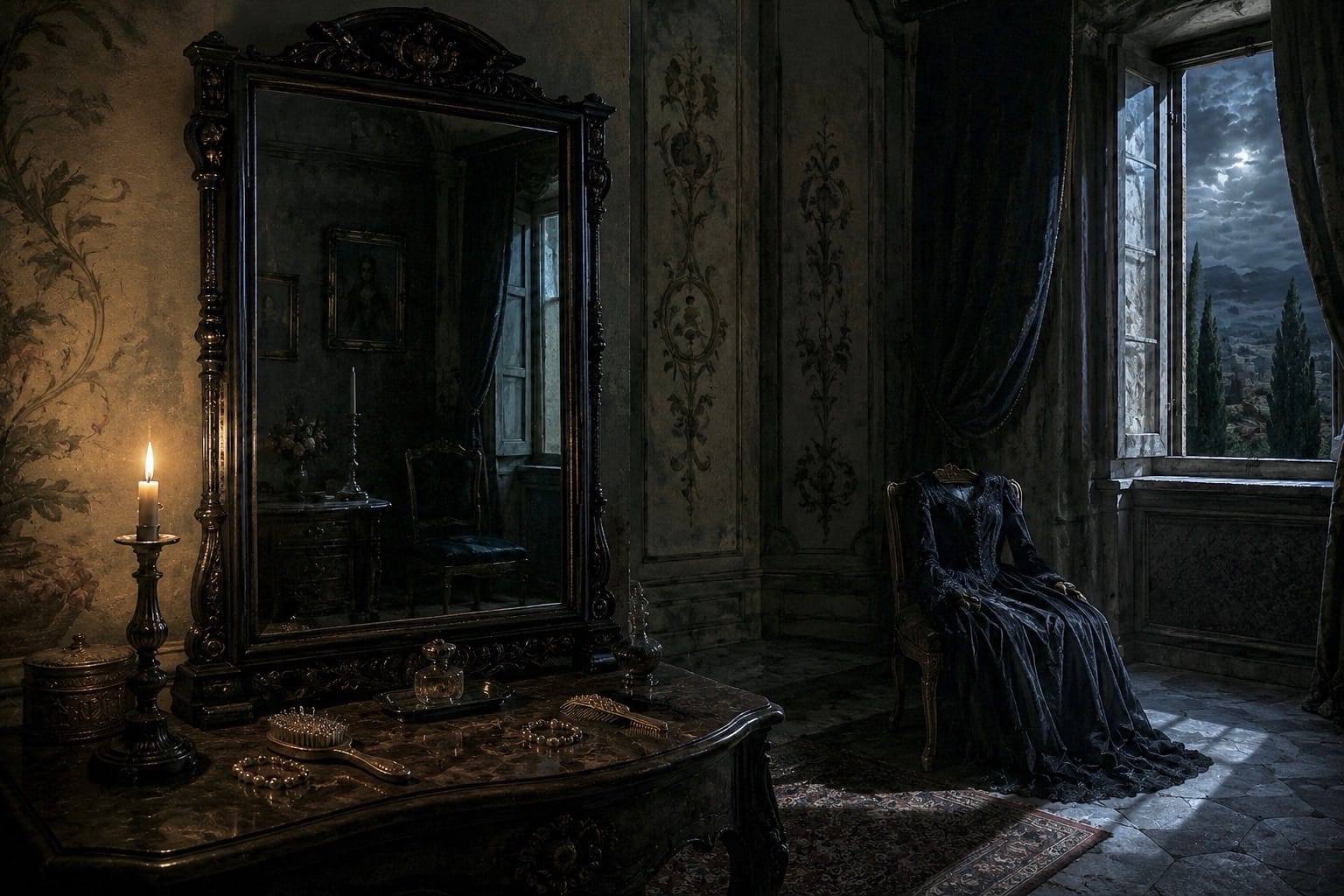
✥ Chamber Tale III
They say she was born too beautiful to live humbly.
Isabetta della Torre grew up in a crumbling villa near Verona, a place where the walls wept salt and vines had long since split through stone. Her father was a once-grand merchant of silk and wine who lost most of his fortune to war and poor wagers — but not before acquiring, for his only daughter, a mirror unlike any in the region.
Tall as a man and framed in blackened walnut and brass, its surface shimmered not silver but deep and smoky, like polished obsidian or wet ink held under glass.
Imported from Venice, it was said to have been cut from glass cooled in the fires beneath San Servolo — spoken of in half-lies and old tongues, passed between mouths the way curses are.
The villagers called it Il Vetro Oscuro. The dark glass.
Isabetta kept it prominent.
She gave it the best wall in the house.
✥
The Visitor
Isabetta was sixteen when the man called Aelius first arrived.
He came not with music or retinue but with stillness — a quality so complete it felt less like temperament than discipline.
His hair was dark as lamp oil, his skin pale and unlined, his voice slow and soft and difficult to argue with. He moved through a room the way a shadow moves: present, unhurried, and somehow already there when you looked.
“I came to see the one who does not age,” he said.
She laughed at him then. But she let him in.
He visited at dusk, never by sun. Always cloaked, always gloved, always standing beside her but never across from her —and never in front of the mirror. She offered him a chair. He declined. She offered him wine. He declined. She offered him her hand, and he simply looked at her and said:
“Your beauty is not what makes you rare. It is your attention to it. You do not waste it.”
She had never been praised for restraint.
It thrilled her in a way she could not name and did not try to.
✥
The Bond
The change came quietly, the way damage usually does — too gradual to locate until it was everywhere.
Her servants began to leave in the weeks after Aelius’s visits resumed. Some claimed they heard her speaking to the mirror in the hours before dawn. Others said the glass sometimes pulsed, like something breathing behind it, a slow and patient rhythm that did not match any sound in the house.
All of them believed there was a curse, and all of them left without being asked.
Isabetta barely noticed.
She had stopped eating grapes — too staining. Stopped walking outdoors — too coarse, too much light, too much weather on the skin.
She sat before the mirror for hours each morning, powdering her skin with mercury, lining her eyes with ash, studying the face in the glass with the focused attention of a woman cataloguing something she feared losing.
Aelius returned every evening. He brought no gifts, made no promises. He offered only presence — and she had come to understand, without being able to say when, that his presence was more than enough.
He never stepped into the mirror’s view.
When she finally asked him why, he was quiet for a moment before he answered.
“The mirror does not know me.”
✥
Unveiling
One night, her voice trembled when she spoke.
“I want to see myself as you see me.”
Aelius was still for a long moment — the stillness of a man who has been waiting for a question and has decided, at last, to answer it. He turned to the mirror. It was the first time he had done so in all the months of his visits, and the act felt less like a choice than a conclusion.
“Then let it reflect truth,” he said.
The glass darkened. Slowly — it moved the way ink moves through water, slow and purposeful, spreading from the edges inward until the candlelight bent and the room behind them disappeared.
Isabetta turned her face to the mirror.
She recoiled.
Her beauty was gone. The skin was pale as scraped bone, hollowed beneath the eyes, the lips bruised and cracked as though she had been cold for a very long time. At her throat, something shimmered — a darkness beneath the surface, like black rot spreading under glass, patient and already deep.
And Aelius. In the mirror, he was not a man. Not entirely human. His smile split at angles a face should not permit. His eyes were hollow — not empty, but hollow, the way a room is hollow when everything has been removed from it.
His shoulders bent like old wood warped by years of bearing weight it was never meant to hold.
Isabetta screamed.
Outside the glass, he remained beautiful.
✥
The Curse
Isabetta tried to shatter the mirror. She threw perfume bottles. Candelabras. Her father’s cane.
She struck the frame until her palms bled and the brass dented. Still the glass did not crack — did not even tremble. It absorbed the blows the way it absorbed everything: without prejudice, without response.
Aelius did not return after that night.
He did not need to.
The suitors came in the weeks that followed, drawn by old rumors of the della Torre beauty. The first gazed into the mirror before he saw her and left in a cold sweat, unable to say what he’d seen. The second collapsed in the garden, weeping for his mother, his hands pressed to his eyes. The third climbed to the east tower and jumped, shouting that he had seen his future and could not endure it.
Isabetta sealed the villa.
What happened to her after that belongs to the kind of history no one writes down.
Some say she turned lye and vinegar on her own face, trying to erase what the mirror had shown. Others say she starved herself before the glass, waiting to become what it already saw. But no account could explain why, decades later, the villa was found perfectly intact — untouched by time, dustless, cold — with the mirror still standing in its place on the wall, patient as ever.
✥
Legacy
The mirror changed hands the way cursed things do: quietly, through estate sales and private arrangements. Passed between people who did not know what they were holding until they had held it long enough.
Some collectors swore it sharpened them — made them more certain, more composed, more themselves. Others locked it away within a week and would not say why. One claimed it whispered names in the dark, names of people he had not thought of in years.
The glass moved through the decades without urgency, as though it understood that time was its means of travel.
Then, in a new century full of chrome and fluorescence and glass on every surface, a boy found it.
He was drawn to its still glass. To the depth behind the surface that seemed to go further than any mirror should.
He stood before it longer than was comfortable and felt, obscurely, that it recognized him — that whatever lived behind the glass had been expecting him with the patience of something that does not need to hurry.
Unlike Isabetta, he did not fear the true face inside. He visited it again the following night.
And the night after that.
Years later, he would carve a sentence into the blackened walnut frame:
The mirror had learned to seduce before it learned to reflect.
✥
This door closes quietly.