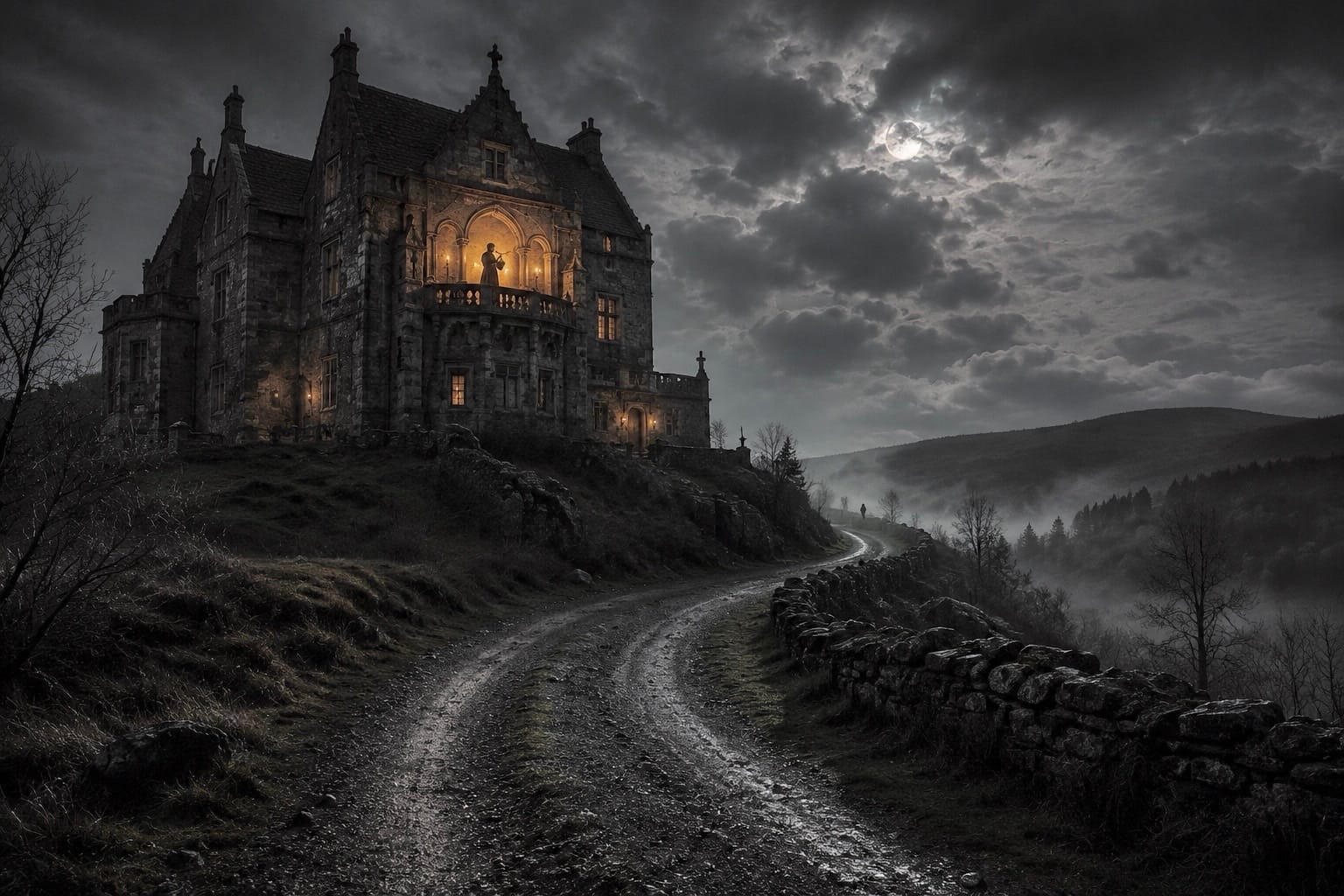
✥ Chamber Tale II
They said the flute was cursed.
Leofric had heard the word before — attached to rings, to mirrors, to old swords pulled from riverbeds by men who wanted a reason for their failures. Curses were the stories the unlucky told themselves. He didn’t believe in them. He believed in tools, and in the hands skilled enough to use them.
This one had been hidden in the reliquary of a ruined monastery two days’ ride north, buried among cracked chalices and rotted vestments, wrapped in waxed linen and bound with a red ribbon gone stiff with age.
The merchant who sold it to him was a small man with careful eyes, the kind of man who chose his words the way a surgeon chose his instruments — slowly, and with awareness of what each one could open. He muttered something about blood, about contracts, about a piper who had vanished with the children and never returned for his fee.
Leofric smiled through all of it. He had a talent for that — for the smile that said I am above this conversation while still conducting it.
“Let them vanish again,” he said, turning the flute over in his hands. It was bone-pale, heavier than it looked, and the holes had been bored at intervals he didn’t fully understand. “I only need one to come.”
He paid in coin, wrapped the flute in his own cloth, and rode home.
✥
Leofric had once been known in three courts. Not greatly known — not the way that mattered — but known.
A minor noble with a facility for music and a charm that moved through rooms like warmth from a well-tended fire. People turned toward him without understanding why. He had taken that for granted, the way a man takes for granted the light he was born into, never considering what it would mean to lose it.
But favor had already abandoned him. His estate sat at the edge of a village that no longer looked up when he passed. His servants had departed one by one, each leaving with the particular dignity of someone who had been patient long enough. His name, when it was spoken at all, was spoken softly, with the brief sympathy reserved for things that had passed their moment and hadn’t recognized it.
He had been trying to reverse this for two years before he found the flute.
✥
What he wanted was not complicated. He wanted the table full again. He wanted the sound of horses on his gravel and candles lit for guests who arrived without being asked.
He wanted to be the reason people leaned in, the way he had once been — effortlessly, without strategy, simply by standing in a room and opening his mouth. He had believed, with the particular confidence of a man who has never had to earn what he once had, that the right instrument would restore it. That a sound beautiful enough would override the silence that now had gathered around him.
A sound that would undo the slow arithmetic of debts unpaid and obligations unmet and warmth not returned.
The flute would sing. People would come. It was so simple.
He set it to his lips on the first evening and played.
✥
The melody arrived whole, as though it had been waiting inside the instrument for years, needing only a mouth to release it. No warble, no tremble. Pure and sweet and almost living, sliding through the empty halls like something that knew the way.
It moved through him rather than from him — his breath, yes, but the shape of it entirely the flute’s own. He played until his arms ached and the candles had burned low, then stood at his balcony in the iron-lantern light and listened to the silence that followed.
He imagined the villagers below pausing at their hearths. Tilting their heads. Wondering.
He lit candles in the hall the next morning and laid out wine on the long-unused table. He trimmed his beard. He rehearsed his welcome — a touch of mystery, not desperation, the right balance of awe and ease.
He played again at dusk, longer this time, letting the melody swell and drift toward the tree line.
No one came.
But he heard things.
✥
On the second night, footsteps on the gravel path — slow, irregular, the sound of something that had traveled a long distance. He crossed the hall in six strides and opened the door to find nothing but mist curling across the grass, the lanterns throwing orange light into air that held it oddly.
On the third night, a breath on the other side of the door. Shallow. Close. He flung it open, smile already in place, and found the path empty in both directions and the trees perfectly still.
He told himself it was wind. He told himself it was the acoustics of old stone.
✥
The dreams began that same night.
People standing in his hall, arranged at intervals as though waiting to be received. Still. Silent. Their mouths open. But their faces — wrong. Not absent, exactly, but unresolved, like wax that had begun to soften without quite losing its shape.
He woke before any of them moved, but the impression stayed with him into the morning, sitting at the back of his thoughts like a guest who hadn’t been invited —and hadn’t left.
He played again. Longer. More urgently.
✥
On the sixth day, a wandering monk arrived at the gate.
He was drenched through, his robe in tatters, a string of wooden beads trailing from one wrist like a severed tether. He did not beg or explain himself. He simply stood in the doorway when Leofric opened it and looked at him with the expression of a man who had arrived somewhere he had not wanted to find.
Leofric offered him the fire, a meal, a dry coat. The monk accepted the fire and nothing else. He sat without speaking, and Leofric — accustomed to filling silence — found himself reaching for the flute.
He played.
When he looked up, the monk’s eyes had gone wide. Not with wonder. With something older and considerably less comfortable.
“That instrument is not meant for music.” His voice was raw with cold and something else beneath it. He did not look away from the flute. “It played once in service of a debt. A pact made in blood, bound to a contract that has never been released. It was not yours to take.”
Leofric set the flute across his knee. “You sound like the merchant.”
“The merchant knew what he was selling.” The monk’s hands moved to the beads at his wrist, working them one at a time. “The one who made the original bargain understood what he owed and to whom he owed it. The flute was payment deferred, not payment cancelled. When it sounds again, the ledger reopens.”
“Whose ledger.”
The monk looked at him then, directly, and Leofric had the unpleasant sensation of being judged rather than seen.
“One who is not concerned with patience,” the monk said. “One who has never needed to be.”
Leofric offered him coin. The monk rose without acknowledging it, gathered his wet robe, and walked to the door. He paused once with his hand on the frame, not turning back.
“Every note you play is not a call outward,” he said. “It is its position. It is your location announced, again and again, to something that has been listening for a very long time.”
He left. He did not look back.
✥
Leofric lit every candle in the manor that night.
He told himself it was atmosphere. He told himself a full house — even a house lit for one — was better than the dark. He polished the wine glasses. He wore his best coat, black with silver trim, cut in a style that had been fashionable six years ago and still suited him, or had. He stood before the long mirror in the hall for a moment, studying his own reflection, and found that it looked back at him with less certainty than he’d expected.
He played anyway.
He climbed to the balcony with the flute in his hands and played the best thing he knew — rising, aching, full of longing and warmth and everything he had once had and wanted returned. The melody moved through the trees and out into the dark beyond them, and he let it go, pouring himself into it with the focused desperation of a man who has stopped admitting he is desperate.
The knock came when the last note faded.
Three. Slow. Heavy. Each one deliberate.
Then silence.
Leofric straightened his sleeves. Smoothed his hair. Crossed the hall and opened the door.
The figure beneath the arch was tall, cloaked in velvet the color of dried blood, the fabric worn to softness at the shoulders. No hood. No mask. Its head was smooth and pale and featureless — not injured, not obscured, simply unfinished, a face had never been assigned.
It did not wait to be admitted. It stepped inside, and the air thickened the way air does before a storm, when the pressure changes and the body understands before the mind does.
Leofric retreated three steps. His mouth opened.
No sound came out.
Not silence in the ordinary sense — not the silence of a man too frightened to speak. Something had been removed. The ability itself. The very idea of voice pulled from him like thread drawn through a needle’s eye, smooth and total and complete. He put a hand to his throat and felt nothing wrong there, nothing at all, which was the worst part.
The figure extended one long hand, the fingers darkened at the joints. In its open palm, a scrap of parchment began to write itself from within, the ink appearing in slow, deliberate strokes, as though whatever composed it was in no hurry.
This instrument was bound before you were born. The debt it carries is not yours to inherit, and not yours to discharge. It was never yours.
Leofric’s other hand — the one still holding the flute — lifted without his choosing. His fingers opened.
The moment the flute touched the figure’s palm, the music stopped. Not the music in the room. The music in the walls, in the stone, in the particular quality of the air that he had noticed from the first evening and taken as confirmation that something extraordinary was happening. All of it. Gone.
The manor went quiet in a way it had not been quiet even in his most solitary months, a silence that was not merely the absence of sound but the absence of the possibility of it.
The figure turned. The each of the manor’s candles went out behind it, one by one, following it toward the door— without wind.
✥
What happened to the manor happened slowly enough that there was no single moment of collapse.
The manor simply became less present. Stone folded into stillness. Glass into absence. And Leofric with them — not destroyed but unmade, the way a fire is unmade when the last of its fuel is consumed. Not extinguished. Finished. With nothing remaining to prove it had burned.
The soil, by morning, remembered nothing.
✥
In the woods nearby, a child woke before dawn to music on the wind.
Soft. Sweet. Familiar the way only things never heard before can be familiar — felt in the chest rather than recognized by the ear. The child sat up in the dark and listened, and the music said nothing and everything, and it came from the direction of the mountains.
The child turned toward it.
The trees stood still, and the dark between them was patient, and the music continued.
It had never been playing for Leofric. It had never been playing for anyone who held it. The flute played to find its way back, and it always did, through whatever hands were credulous enough to carry it, through whatever hunger was bright enough to serve as a beacon.
Someone would find it again.
Someone always did.
✥
This door closes quietly.