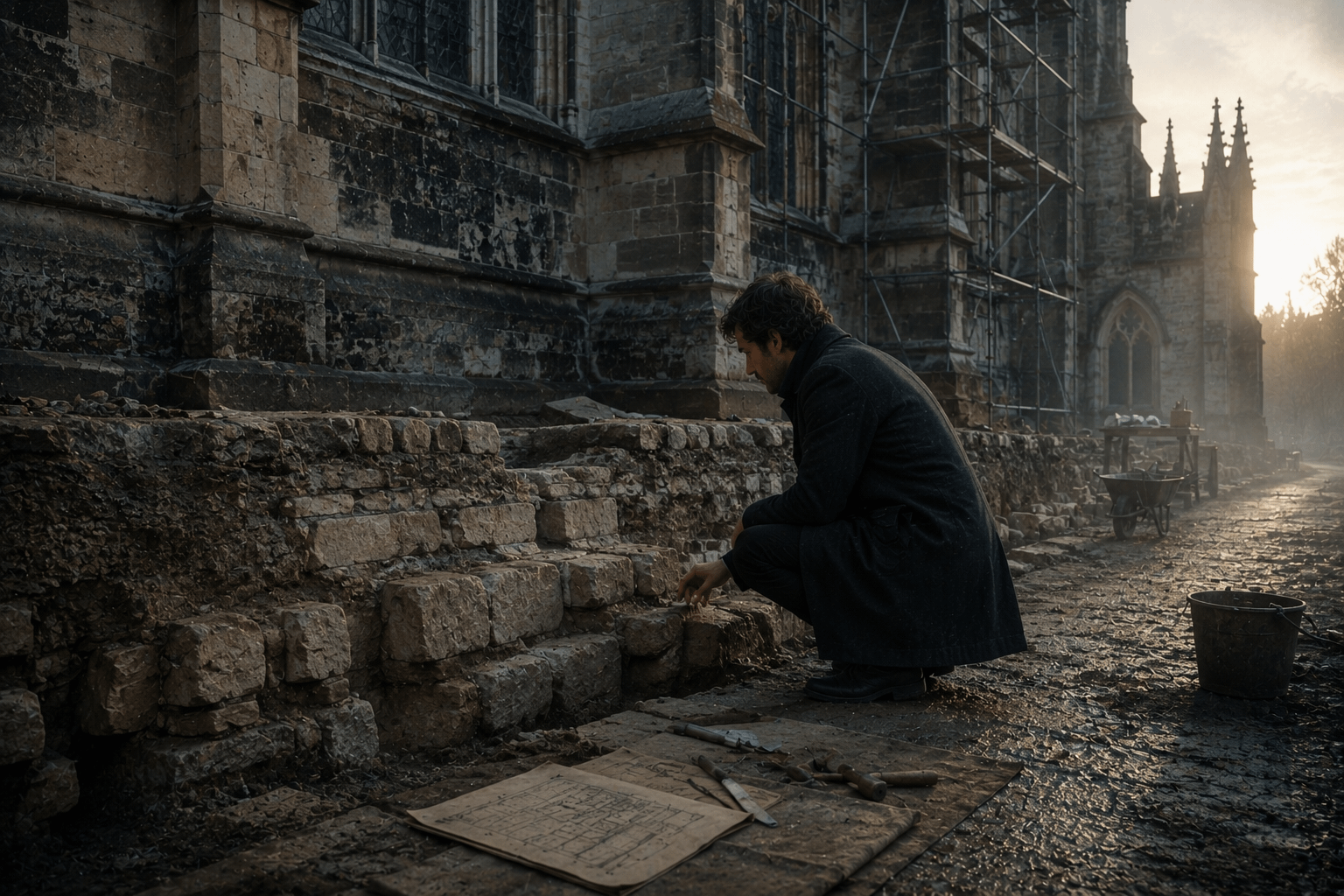
He was hired because he did not interrupt.
Padre Esteban Arriaga noticed this during the interview and said nothing about it, which was itself a kind of confirmation. The office was narrow. One window. Shelves pressed with books that had not been opened in years. Arriaga spoke of needs rather than expectations — support work, verification, routine review. Nothing requiring initiative. Nothing requiring judgment.
Tommaso listened the way water listens to a slope.
He asked one question, and only after the priest had begun gathering the papers that signaled the conversation was finished.
Which language should I prioritize?
Arriaga paused.
Latin, he said. Would be preferred..
❧
Tommaso had come from Italy two months earlier with no particular plan to stay. The work was temporary. The arrangement provisional. He told himself this while signing the forms, while accepting the modest salary, while thanking Arriaga with an earnestness that made the man briefly uncomfortable.
Gratitude had a way of doing that.
His desk sat at the back of the administrative wing where the light thinned before it reached the floor. He was given a key that opened fewer doors than he expected. The work was what it had been described as — inventories, cross-references, margin corrections in documents that had not been carefully read in decades.
He corrected a misfiled year without mentioning it.
Adjusted a translation where the original Latin had been smoothed into something more comfortable than accurate.
No one remarked on either.
This suited him. Precision was easier when it attracted no attention.
❧
On his third week Arriaga left a small stack of files on his desk, tied with twine.
Preservation-related, the priest said. Preparatory work. Routine.
Tommaso carried them carefully. He did not open them immediately. He waited until the corridor outside had emptied, until the last footsteps had faded toward evening obligations.
The first document was a survey. The second, a permit. The third was a copy of a deed, reproduced by hand long before machines were trusted to remember.
He noted the date.
Then noted it again.
It was older than the cathedral.
He did not assume this meant anything. Old things often outlived their relevance. Still, he marked the page lightly in pencil — not to accuse the text, only to return to it.
Outside, a bell rang once.
Then stopped.
Tommaso retied the twine and placed the folder in the tray marked for follow-up. The action felt measured. Appropriate.
He did not feel urgency.
Only the faint discomfort of an unspoken sentence dying to shout.
❧